Sunday, April 14, 2019

Go get yourself some cheap (safety) sunglasses...

I have to make a confession... while I have a fairly expensive set of Oakley Radar shooting safety glasses... and a couple of other more costly brands too... more often than not, you'll find me wearing a set of Walmart's Safety Vu Bifocal Safety Glasses.


Yep, that's right... most of the time on the shooting range, in the shop, working around the barns, weed-wacking, grinding, drilling, chainsawing, mowinig, hunting, woodworking, walking through the woods... I'm wearing $5.97 safety glasses. Go ahead... don't read another word... jump straight to the comments and fire away... it won't likely change what we do around here.


The gals and I have been using the Walmart Safety Vu's for years and maybe I can summarize why:

  • They're inexpensive, so you can have multiple sets all over the place and so there's no excuse for not wearing some eye-pro. There's clear ones and tinted ones ready to go... the car, the suv, the truck, the barns, the tractor, the motorcycles, the workbench, the mower... you'll find them all over around here.
  • We've tested them ourselves and have used them for years.
  • The wrap-around styling protects the eyes from objects coming in at angles other than straight on to the face.
  • They're comfortable with soft-rubber nose and ear-pieces. They rest easy on your nose and don't cut into your ears or hurt the sides of your head when wearing hearing protection like our 3M Peltor Sport-Tac's.
  • Even after being dropped on the gravel drive and on the concrete barn floors multiple times, they've proven themselves to be fairly scratch resistant, something I can't say for my prescription eye-wear in the past.
  • You can get them with bi-focals! Sometimes they're called magnifiers or readers. Yes, for those of us in the second half of our first century... having those "helper" lenses built-in work great for seeing those tiny screws on guns and many other things.
  • They can be had in clear, tinted, and amber (yellow)... with and without the readers... and the reader bifocal lenses can be found in several magnification powers... we've seen +1.50 up to +3.50.

We shot a set of our Walmart clear Safety Vu glasses with #8 lead bird shot from a 12 gauge shotgun seven or eight years ago just to test them for ourselves. I repeated that test with a new set purchased this weekend just for this blog post. 


The results of multiple pellet hits to the protective lenses were the same as years ago. Nothing penetrated the lenses, the glasses and frames remained intact.


There are dimples to the inside of the lenses from the shot pellets' impacts, but they did not crack or penetrate the lenses. You can also see the very comfortable nose pieces in this photo.


We also keep a couple of boxes of the ULINE ICE Wraparound safety glasses on hand for folks that forget their eye protection. I also included a set of those for this test since it's been a couple of years since we purchased and tested the ULINE safety glasses.


The ULINE Ice Wraparound performed just as well as they did a couple of years ago when we shot them. Dimples, but no penetration, cracks, or frame failures. They are not as comfortable as the Walmart Safety Vu's, but you can buy a box of twelve in a number of tints and colors or clear for $2.50 each!


Now, please let me be clear... I'm not an expert on safety glasses... the ANSI Z87.1 standards that OSHA goes by... or the MIL-PRF 32432 standards the military uses. Honestly, it doesn't really matter to me, because anybody can slap a sticker on safety glasses that says they meet a standard. The gals and I know these safety glasses will meet our anticipated needs because we've tested them ourselves.

If you're interested, Lucky Gunner had a great review of eye-pro a few years back that tested a lot of eye protection over a variety of price ranges. By the way... you notice that in their review... some of the most expensive eye-protection was good, but not the best performing when compared to others when tested.

Now, will the eye-pro I mentioned stop a bullet... like even a small .22 long rifle... no... but from my time in law enforcement years back... I've personally witnessed two different dead dudes whose skulls didn't stop a .22 long rifle... eye protection isn't a big factor with a direct hit to the head from any caliber bullet fired from a gun.

Our recommendation... if you are buying cheap eye-protection... get two and test one... who knows... you might be just like ZZ Top and... Go get yourself some cheap (safety) sunglasses...

Monday, April 8, 2019

Every Day Preparedness for Regular Folks: The Dorcy LED Mini Lantern...

Sometimes inexpensive is cheap... and sometimes inexpensive is good enough. Good enough is right where the Dorcy LED Mini Lantern falls in providing a good, portable, and affordable light source for regular folks during a power outage, while camping, or just for temporary small-area lighting.


The Dorcy LED Mini Lantern operates on four AA batteries and the manufacturer claims they will run for 70 hours on a set of alkaline AA batteries. The gals and I tested one of our lanterns with a brand new set of Amazon Basics AA alkaline batteries and while the lantern's LEDs did dim down a bit at the end... they lasted just over 76 hours!

They don't even list the lumens for the four little 5mm LED bulbs that light this lantern, but these lanterns are not meant to light up a 400-yard perimeter at the bug-out compound. What they do well is lighting up areas of your home during a power outage or a tent while camping. A hook is built into the carry handle and folds out to hang the lantern in your tent, or from many things as the lanterns don't weigh much at all.


In the photo above taken with the iPhone... you can see that it throws a nice, even white light for 360 degrees around the lantern. We've even knocked one of ours off the kitchen table... it hit the hard floor and bounced a couple of times, but never broke.

There are better, brighter, and more rugged products out there like the Streamlight Siege X, but when you can pick up one of these for under six-bucks... or a three-pack with batteries for under seventeen-bucks at Amazon... they're easy on the budget. We've had a couple of these lanterns for over two years now... and recently picked up a couple more. They were worth every penny this winter during a two-day power outage.

So... our recommendation for Every Day Preparedness for Regular Folks: The Dorcy LED Mini Lantern...

Saturday, March 30, 2019

Guys... don't box yourselves in.

Sometimes, you just can't make stuff up that's as dumb as reality. I recently saw a man in a public restroom set his pistol on the top of the urinal while he relieved himself. Now before you think or say you'd never be that dumb... would you use a wall-mounted urinal in a public restroom in the first place? Guys... don't box yourselves in.


I honestly can't remember the last time I used a wall-mounted urinal in a public restroom. It's also been six years since I posted about concealed carry and public restrooms, so maybe it's time to touch base on a few tips to consider when you're leaving yourself more vulnerable doing your business in such a private, transitional space as a public restroom.

So here are some recommendations and tips, in no particular order, for using a public restroom while carrying a concealed gun:
  • Practice at home. Before you head out, try your gear and set-up at home in the bathroom. If you can safely do so... do some dry-fire practice... accessing your gun while "doing your business" in the bathroom at home.
  • Practice pulling your pants up with your unloaded gun still holstered and attached to your belt. 
  • Use the stall, not the urinal. The urinal leaves your back to any potential threats and you're boxed in with no easy escape routes. I prefer to use the stall farthest from the entry door to the restroom, and in a corner if possible to minimize avenues of threats.
  • Leave your gun holstered and attached to your belt... even if it's down around your ankles. 
  • AIWB (appendix inside-waist-band)... or what we used to call one o'clock or belly-carry position in the old days... or a forward, strong-side hip-carry... work well when using the restroom for me.
  • If you can't do your business with the gun holstered and attached to your belt, then leave the gun in the holster and remove the holstered gun. Set it safely and securely in your pants between your legs... always being mindful of where the muzzle is pointing.
  • Don't set it on the back of the toilet or toilet-paper holder, you might forget it. You won't do that if it's still attached to your belt or you set it in your pants between your legs.
What tips and thoughts do you have to share? Just remember... Guys... don't box yourselves in.


Saturday, March 23, 2019

Making space... before you need it!

I recently read a story about a gal who was assaulted and robbed between her vehicle and the fuel pumps while filling up at a gas station. I thought I'd share a simple tip: Create space at the pump!

You don't have to park right up tight, next to the fuel pumps. Most "lanes" between pumps at gas stations are large enough for a semi-truck or a large pick-up with "dualies" to pull through with plenty of room, so leave some space between your vehicle and the fuel pumps.


Park with a good three to four feet of space between your vehicle and the fuel pumps. That is usually enough space to allow you to exit the opposite direction of a person poses a threat to you. It's also enough space that makes it more difficult for two threats or attackers to "box" you in between them, the fuel pumps, and your vehicle.

Some additional tips to consider while fueling up:

  • Be observant. Yes, situational awareness. Whether it's a suspicious person or driver in another vehicle who isn't paying attention, gas stations are transitional spaces where both accidents and attacks can occur. Also, be mindful of someone trying to distract you while an accomplice takes advantage of you being distracted.
  • Lock your doors. If you're not in your vehicle, someone can get in via an unlocked door to steal your vehicle or something in it. If you're in your vehicle checking your phone, resetting your instrument panel, or whatever... an unlocked door will allow an attacker to get to you when you are vulnerable and distracted.
  • Don't leave your vehicle running. A running vehicle with an unlocked door is an easy target and car thieves look for it. Also, if you have children in the vehicle... a running vehicle with children inside and no adult is a recipe for disaster.
  • Leave space between your vehicle and other vehicles in front of and behind you. That will allow you to pull out and "escape" in your vehicle if needed. If you pull up tight behind the vehicle in front of you at the fuel pumps, a vehicle can pull in behind you and easily leave your vehicle blocked/boxed in.
  • Be patient, be polite. Getting into an argument about who was in line first or who "stole" a fuel pump spot from who isn't worth it. Smile, relax, and enjoy a couple of minutes of life while letting that other potential road-rager get their gas and get out of there.
There are many other tips that could be shared about gas stations, personal defense, and safety... but we'll focus on this specific aspect for now. What tips do you follow when you're at the pumps?

Stay Safe!

Dann

Sunday, March 12, 2017

Daylight Savings Time... our semi-annual readiness check.

Well, I'm still looking for that hour I lost last night, but we should get it back next fall. Twice a year... here in Ohio... we change our clocks for Daylight Savings Time. While the advantages gained are debatable... it's our semi-annual reminder to check our stuff. What stuff you ask, well... a lot of stuff... it's been a busy day(s)!


First off, this weekend we shot our Every Day Carry (EDC) ammunition and replaced it with new.  This has been discussed in the past with "Five reasons to shoot your Every-Day-Carry Self-Defense ammunition!" It's also a good time to check your cartridges for any set-back you might be experiencing.  We rotate the round we chamber each time and haven't really experienced a problem with bullet set-back in the cartridge because we don't re-chamber the exact same round over and over and over every single day.

We also do a lot of other checking this weekend. We check our Bug Out Bags (BOBs) and Get Home Bags (GHBs). We update anything that needs it, rotate out expired provisions if necessary, and add in anything else we've decided to at that time.

We also check batteries... and replace if necessary... in radios, flashlights, weapon lights, red-dot optics and other devices well beyond the typical smoke alarms and carbon monoxide detectors found in most homes. The portable generators are started and checked... annual maintenance like oil changes, etc. happens each fall when the clocks change.

Have you checked your vehicles over... checked the air pressure in all five tires...yes five... that spare won't help if it's flat too. How about your prepping supplies... food stores... like the pantry to make sure any close to expiring goods are moved up front in the rotation and expired goods are discarded. Medical supplies and medicines are also checked, updated, and/or discarded as needed.

How about some personal identity security? We're no cyber saints around here, but we do update our passwords on all our accounts at least twice each year... when the clocks change.

The list could go on and on... and it takes us several days to go through everything... and that's why we actually have a checklist... you should too... and maybe you should do like us... because we make... Daylight Savings Time... our semi-annual readiness check.

Tuesday, February 21, 2017

I'm a pretty good shot... and hand, finger, and grip strength have a lot to do with it.

While most of the firearms we have are "stock", we still have quite a few with modifications... including various "trigger jobs" on rifles, shotguns, and handguns. A friend recently told me he was ordering a "Ghost Trigger" for his Glock because the gun's stock trigger pull was messing up his "groups". Now... I have a couple of Ghost products and they do a pretty good job on different guns, but a "trigger job" is what a lot of folks turn to rather than work on fixing themselves first. A "trigger job" won't fix a poor application of the shooting fundamentals or... make up for a lack of hand, finger, and grip strength.

Ruger SR9... my usual EDC... demonstration for students... draw and fire...
controlled pairs... flash-sight picture... at five yards...
.22LR single shot in bullseye was demo from ten-yards with Ruger Mark II Government Target Model...

Don't get me wrong, there are mechanical modifications and accessories that can truly improve a shooter's performance... but only if the fundamentals and decent hand and grip strength are already in place. I've shot some S&W M&Ps and Glocks that were amazing guns after folks like Bowie Tactical Concepts and Boresight Solutions had worked their magic, but for the most part beyond sights... our Every Day Carry guns around here are bone stock... and I shoot them pretty well because of two reasons... in my humble opinion... I have a pretty good grasp and application of the fundamentals... AND... I have developed and maintain pretty good grip and trigger-finger strength.

Ruger SR9... demonstration for students... trigger-control focus... ten-shots... at five-yards...

Most folks these days don't do a lot of manual labor, especially manual labor that works fine motor skills to where they build up strength in their hands and fingers, especially with regard to their grip. There are even some regular "gym rats" I know that haven't been purposeful about building hand and grip strength on the same level as their biceps and triceps. Now I've had students that have limitations due to injuries, arthritis, and other problems, but that's not the majority of folks. Also, I'm not picture of overall fitness... I do exercise... but I'm also a fat guy who could stand to lose a few or eighty pounds... but I have still developed very good hand, finger, and grip strength.

So, let's identify some of the advantages to great hand, finger, and grip strength:
  • Easier manipulation of the firearm's action and controls.
  • More consistent trigger press and management regardless of trigger weight.
  • Stronger grip for two-handed and one-handed shooting.
  • Better recoil control for controlled pairs or follow-up shots.
  • Better retention of the firearm if someone tries to take it from you.
  • Less fatigue when doing a lot of shooting.
Glock 17 Gen4... three shots draw and fire... then ten shots...
trigger-control focus... all at three yards...

So the next question is... how do we improve our hand, finger, and grip strength? Most people I know, even those who work-out at a gym, are not necessarily purposeful about building hand and grip strength. Regular shooting and dry-firing is great for developing your fine motor skills as they relate to shooting, but it doesn't necessarily build the strength in the hand, grip, or trigger finger any more than a weight-lifter doing curls with a five-pound dumbbell every day. 

S&W M&P9... eleven shots... seven yards...

You need to be purposeful about building hand, finger, and grip strength and fortunately... you can do a lot by incorporating it into your everyday activities. I do a lot of my grip exercises while driving to work. So if you want to build hand, finger, and grip strength... here are some exercises to try:


  • Grip Exercisers - Equipment: grip exerciser or ball... I still use the GripMaster daily.
  • Arm-Hang and Towel-Arm Hang - Equipment: chin-up/pull-up bar, towels.
  • Wrist Curls and Hammer Curls - Equipment: dumbbells, kettlebells.
  • Pinch Curls - Equipment: Weight plates, heavy books,
  • Farmer's Walk - Equipment: Dumbbells, buckets with water/weight in them.
  • Hand Stretch - Equipment: Stretching bands or heavy/larger rubberbands
Here are some links that explain the some of the above exercises and other exercises you can do at the gym or at home:
I'm not saying a trigger-job or stippling your grips on your gun won't help, but I think you'll find that as you develop your strength... you'll see your shooting improve... and that's why I believe... I'm a pretty good shot... and hand, finger, and grip strength have a lot to do with it.


Thursday, February 2, 2017

Pepper-Spray should be part of your Every Day Carry...

After recently spending some time answering questions and discussing pepper-spray with several different folks, I decided to post some of my thoughts about carrying pepper-spray for defensive use. In the spirit of full disclosure, I am a SABRE Red certified instructor, often recommend their products, and the gals and I carry their products daily.

So, in no particular order, here are some thoughts:

Pepper-spray should be part of your Every Day Carry for self-defense: Pepper-spray is inexpensive, easy to use with training and practice, is legal to carry on all 50 states (but check your state's laws), and is typically non-lethal. Pepper-spray will usually not completely disable an attacker or aggressor, but it will often give you the chance to at least slow down the threat, create distance between you and the threat, and hopefully escape the situation and contact law enforcement... yes... anytime you have to use your pepper-spray against a threat... call the police!


Pepper-spray can be legally carried many places that a gun, and even some knives, can't be carried: My wife and I both teach in public schools... my daughter is an ER nurse at an area hospital... we can't legally carry a firearm at work... and until the law changes here in Ohio on March 21st of this year... we can't even keep a gun in our vehicle on school premises. We can carry pepper-spray. Many personnel policy manuals don't forbid carrying pepper-spray, but most forbid guns and knifes of defensive length or size. Also, know your state's laws regarding defensive sprays. I am not an attorney, but one of the best summaries I've found for the legalities of purchasing and possessing pepper-spray in different states is on Ebay.

Pepper-spray should be carried in your hand, ready to use: You need to carry your pepper-spray in your hand and be ready to use it in various situation and contexts... especially in transitional or vulnerable spaces... jogging on a trail, carry it in your hand or on your body... leaving the store, headed for your vehicle in the parking lot, carry it in your hand. If your pepper-spray is buried in your purse, or in your pocket tangled up with your keys... you likely won't be able to deploy it quickly enough when you need it. I carry my pepper-spray and keys in my left-hand (weak-side) and practice using it with my left-hand because I wear my gun on my right side, either AIWB or IWB.


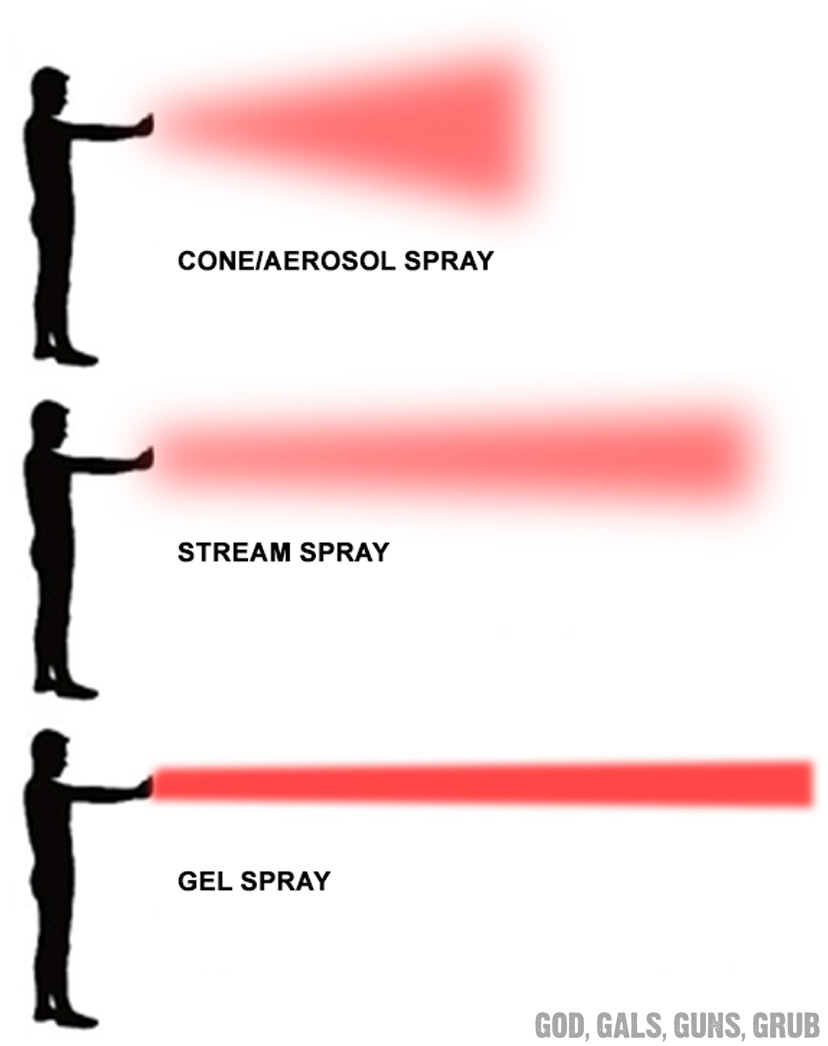
Pepper-spray allows you to engage a threat at a short distance, but beyond arm's length: Unlike empty-hand techniques, stun guns, impact weapons, and many other defensive tools... pepper-spray can be used to defend against an attacker or aggressor beyond your arm's length. Different pepper-sprays have varying distances of effective use and that is why it is important for you to practice with whatever pepper-spray you carry. I have found the pepper-gel products by SABRE Red to have an effective spray distance of twelve to fifteen feet. The other advantage to the pepper-gel is that there is less chance of it blowing back in your face due to wind, but you also have to be more purposeful in aiming the pepper-gel products. The gals and I also like and carry the SABRE Red Spitfire which is natural to carry and aim, has replaceable cartridges, and has a "stream" of spray that extends the reach of the spray out further than typical cone/aerosol pattern sprays.


Pepper-spray is typically non-lethal, as are many of the physical threats you will face: In most states, defensive size/designed knives and firearms are considered deadly force. Again, in most states, you can only legally use deadly force to defend against an immediate threat of death or serious bodily harm.  In many defensive situations your firearm is of no use... yes, it's true. There is a lot that an aggressor or attacker can do to an average adult in many contexts and situations before you are ever near the threshold of defending yourself with deadly force.  The attacker can push you, chest-bump you, spit in your face, finger-thump you in the chest... and in many of theose situations and contexts... if you pull out the gun and shoot... you're going to jail. Pepper-spray gives you another tool in your personal defense force continuum. Beyond humans, pepper-spray is also very effective against animals... like an aggressive or attacking dog and even an aggressive raccoon... from personal experience.

Pepper-spray is a self-defense tool for those who may not be ready or want to carry a firearm: Yes, I know in the gun-folks circles and those who consider themselves "in the gun industry"... that a firearm is considered a great defensive tool, if not THE defensive tool. Truth be told, there are a lot of folks out there that would like to defend themselves that just aren't ready to carry a firearm daily for a variety of reasons. Pepper-spray gives them another defensive tool... a tool... as previously mentioned... that may have more potential for use than a firearm.


Pepper-spray is not tear gas and not all pepper-sprays are created equal: First, since the term "pepper-spray" seems to be generically applied to all defensive sprays, you should know the difference between common defensive spray products. OC sprays use capsaicin and/or related compounds called capsaicinoids. They cause significant irritation (a pain response) and severe inflammation (a physical response) of the oral, nasal, conjunctival and tracheobronchial mucous membranes . OC sprays are usually more effective for defensive use because an attacker can fight through the pain of the irritation caused other sprays, but the severe inflammation aspect caused by OC sprays can't be controlled by the attacker... it's the body's natural response to the OC spray.

The other common defensive sprays... often referred to as "tear gas"... contain either CS which uses 2-chlorobenzalmalononitrile or CN... often known as "Mace"... which uses phenacyl chloride. Both CS and CN sprays are irritants and the effect on the person sprayed subsides more quickly than the effects of OC sprays. The "heat" or "hotness" of OC pepper-spray is measured in Scolville Heat Units (SHU) and varies from product to product. The bottom line is you want a good quality OC pepper-spray and I typically recommend products with at least a million SHU rating from SABRE Red and Fox Labs.


Pepper-spray use, to be effective, requires training and practice: Just like every tool used for self-defense, including firearms, to effectively use pepper-spray you should get some training and practice regularly. SABRE Red offers training and there are a lot of terrific instructors out there like Greg Ellifritz of Active Response Training, Chuck Haggard of Agile Training & Consulting, and myself with G4 Personal Safety in Ohio who offer it too.


You should also practice. Purchase inert pepper-spray units to practice... and when you replace your pepper-spray, use your expired pepper-spray and practice.


Pepper-spray is designed for results on people, wasp spray is not: Folks, this wasp spray nonsense has to stop! Will wasp spray possibly sting or burn in someone's eyes... maybe... but good a OC pepper-spray uses a hot pepper extract that will severely affect the the eyes and mucous membranes causing significant inflammation and irritation. If you want to see a demonstration of wasp spray, check this video out by SABRE Red.

Pepper-spray will not cause you legal problems if you carry a gun: What will cause you trouble is YOU not knowing the legal principles and laws as they relate to the use of force for self-defense. I am not an attorney, but Andrew Branca is and you should take one of his excellent seminars. Aside from that,  the bottom line is you can only use deadly force to defend against the threat of deadly force or serious bodily harm. If an attorney or prosecutor wants to know why you used your gun instead of pepper-spray for self-defense... then you better be able to explain that you were threatened with deadly force or serious bodily harm. If you were threatened with a little bodily harm and a bruised ego, YOU CAN'T USE YOUR GUN! You could use your pepper-spray. Now, every situation is different, so I have no interest in going down the rabbit holes of every possible context of when, if, maybe, hypothetically... just carry pepper-spray!

A lot of thoughts to think over... and there are many more to consider... but for now... don't you think... Pepper-Spray should be part of your Every Day Carry...