Showing posts with label Sheepdog 101. Show all posts

Sunday, March 12, 2017

Daylight Savings Time... our semi-annual readiness check.

Well, I'm still looking for that hour I lost last night, but we should get it back next fall. Twice a year... here in Ohio... we change our clocks for Daylight Savings Time. While the advantages gained are debatable... it's our semi-annual reminder to check our stuff. What stuff you ask, well... a lot of stuff... it's been a busy day(s)!


First off, this weekend we shot our Every Day Carry (EDC) ammunition and replaced it with new.  This has been discussed in the past with "Five reasons to shoot your Every-Day-Carry Self-Defense ammunition!" It's also a good time to check your cartridges for any set-back you might be experiencing.  We rotate the round we chamber each time and haven't really experienced a problem with bullet set-back in the cartridge because we don't re-chamber the exact same round over and over and over every single day.

We also do a lot of other checking this weekend. We check our Bug Out Bags (BOBs) and Get Home Bags (GHBs). We update anything that needs it, rotate out expired provisions if necessary, and add in anything else we've decided to at that time.

We also check batteries... and replace if necessary... in radios, flashlights, weapon lights, red-dot optics and other devices well beyond the typical smoke alarms and carbon monoxide detectors found in most homes. The portable generators are started and checked... annual maintenance like oil changes, etc. happens each fall when the clocks change.

Have you checked your vehicles over... checked the air pressure in all five tires...yes five... that spare won't help if it's flat too. How about your prepping supplies... food stores... like the pantry to make sure any close to expiring goods are moved up front in the rotation and expired goods are discarded. Medical supplies and medicines are also checked, updated, and/or discarded as needed.

How about some personal identity security? We're no cyber saints around here, but we do update our passwords on all our accounts at least twice each year... when the clocks change.

The list could go on and on... and it takes us several days to go through everything... and that's why we actually have a checklist... you should too... and maybe you should do like us... because we make... Daylight Savings Time... our semi-annual readiness check.

Tuesday, December 15, 2015

We live with guns...

Our dogs are part of our family. I've always said that we don't own them, we live with them. They live in our home and our lives fully.  Recently, our friend Melody Lauer made a comment on Facebook about living with guns. Our family is the same with guns, they are an integral part of our everyday lives for self-defense, fun, sport, hobbies, reading, learning... just about whatever.


The one gun safe is in our kitchen right next to the refrigerator. We tend to be in and out of both the refrigerator and gun safe twenty-four-seven. Heading out to the barn, grab a bottle of cold water and an AR in case a coyote decides to get within range. Heading out to the shooting range out back, grab a shotgun, an extra couple of mags... and hmmm... haven't shot the gal's Smith & Wesson 9mm Shield in a while... let's grab that. Maybe that Glock 19 would go better with the gal's outfit today. Heading to 4H Shooting Sports, grab a few guns to take along like that Ruger MKII Government Target model and that Ruger 22/45 Target model.

Our daughter grew up living with guns and she was taught safety and shooting fundamentals early on and the idea of living with guns keeps us always in the mode of safety, mindset, and where our guns are at any given time... and they're not always in the safe... we carry around home too. We're actively involved as firearms instructors and in shooting sports, hunting, and just about anything that involves shooting... it's just our "thing". Truth be told, there's usually not many places we are in our lives.. home, vehicle, barn, or out and about... that there isn't a gun handy.

Now I know a lot of people own guns. They have that shotgun they get out for hunting every fall or the gun that "gramps" passed down to the family or that pistol bought for home protection that hasn't been fired in three... err... six... uhh... seven years. So, maybe a question you might think about... Do you own -or- do you live with guns?

We live with guns...

Friday, June 26, 2015

Six Self-Defense Commands and Strategies for Families…

Every parent wants to protect their family, children, and loved ones… but few have actually taken the time to plan, prepare, and practice for emergencies and violent encounters with their families. Now please understand that preparing for the possible is not the same as being paralyzed by paranoia. You don’t have to scare your family to death or force your significant other or children into actions or areas they are not comfortable with... but taking a practical, thoughtful approach will allow you to implement some basic commands and strategies for you, your family, and loved ones to use in case of an emergency.

I really began thinking strategically about incorporating the entire family and household into the process back in the 1980s and 1990s when I worked in law enforcement… and especially about age appropriate commands and strategies when my daughter was born in 1995. My elementary teaching wife has been a terrific asset in applying age appropriate pedagogy and strategies... and over fifteen years of teaching shooting sports to 4H youth ages 8 to 18 has really helped me understand the capabilities and limitations of what you can expect from kids.

John Correia over at Active Self Protection occasionally has good video analysis of self-defense situations involving families and children over at Active Self Protection… and my friend, Melody Lauer, has really created some positive buzz with her baby-wearing and carrying self-defense classes. While there has been occasional mention of integrating families, loved ones, and especially children into self-defense planning here and there by the "big name" trainers and schools… there is still not a lot of quality, in-depth information or instructional opportunities out there on these matters for average people… so I intend to begin sharing my experiences and thoughts here on the blog… at least to start some discussion and continue my learning, if not your learning, in preparing for protecting your family, children, and loved ones.

First, let me explain some of the philosophy behind the approach we’ve taken with our family over the years... KISS… Keep It Simple, Stupid! You need to have plans in place in advance and that often starts with developing commands and strategies that will work for everyone... this is not a tactical squad of operators… but every day, average people who are more likely to trip and fall on the sidewalk than run into a marauding band of rioters or armed felons. You need to keep a short list of simple commands that can be easily communicated, understood, and applied in various situations.

Second, you don’t need to create a tense, paranoid, state of fear in your family, children, and loved ones. You can use ongoing visualization, practice, and even “games” to get everyone prepared, trained, and ready to act upon command.  Additionally, you don’t need to get caught in the details and nuances of various strategies… as an average five-year-old should be able to understand, implement, and follow through with your commands, strategies, and plans.

Third, your commands need to be simple... using the tone and urgency of your voice with straight-forward phrases is preferable over a bunch of code-words and clandestine signals that will be hard to remember or understand in a true, high-stress, emergency or critical situation. Your strategies should likewise be simple, adaptable, and easily followed and applied in various situations and environments by everyone involved. This will allow mostly predictable results in completely unpredictable circumstances.

So let’s take a look at Six Self-Defense Commands and Strategies for Families:

Come Here...

Most parents have said this a thousand times to their children, but you need to make sure that your entire family recognizes your voice, tone, and urgency as to when this command is not optional and that they need to employ a strategy of immediately coming to you and positioning themselves as you have predetermined. In most situations while we were out and about... my daughter and wife knew to come to me and position themselves behind and to my left as my gun is holstered on my right hip. My daughter knew to take my left hand upon this command to the point I could simply extend my left hand down and out in a certain, discreet manner and she’d slip her hand into mine within seconds.

In the home, this command would mean to come to wherever you are… the bedroom, the kitchen, the garage, the front porch… it means come here... AND NOW! This applies in the store, in the parking lot, in a crowd, at school, in transitional spaces… no matter where you are, they know what is expected with this strategy when the command is issued.

Get Down...

This command is as simple as it sounds. You need to be able to issue this command and have your family “get down”. Whether you are at the park, the store, a parking lot, at church, in your home, in your yard… you need to have your family ready to hit the ground or floor, lying as flat as possible right where they’re at unless preceded by another command.  Yes, you may casually use the phrase “get down” while telling your child to get off a fence or a couch or a tree... but they will know the tone and urgency of your voice in a self-defense situation or emergency and they can discern the difference.


This command and strategy can be applied in almost any situation or environment. You can even make a game out of it and practice with the whole family, even the kids. Teach them how to fall, dive, hit the ground fast without injury… even play dead! It may involve a specific location and manner to Get Down… like in our home, if I give the Get Down command to my daughter while she is in her bedroom, there is a predesignated place she is to Get Down and stay at until further commands or a change in the situation. In other locations, you might have your family discuss how or where they would Get Down.

Get Cover...

We are not going to argue about cover verses concealment here. Keep this simple… as if you’re working with an average five-year-old child. Get Cover for a tornado may mean going to the basement or under a table or desk for your family, depending upon your situation… but it should be discussed ahead of time so the best places are predetermined. Get Cover for a hail storm may mean get out of the front yard and get into the garage or under a shelter. Have your family, especially your kids, thinking about it... what makes good cover.


Get Cover in a violent or aggressive confrontation might mean running and crouching down by the wheel and tire of a nearby car in a parking lot on the side away from the aggressor or threat. This is something that can be practiced as a “game” in the parking lot at your local Walmart, as we did with my daughter fifteen-plus years ago… on a slow day under careful supervision. It might mean getting down behind a counter and cash register in a check out aisle at the grocery store. It could mean running and taking a position behind a garbage container in a public park. Ask and discuss with your family and loved ones, especially your kids, what they would use for cover and why... and explain why some of their choices are better than others... educate them!


You need to think this through, visualize possibilities, and develop “learning games” for your family. Ask a four-year-old at the grocery store where they would go if you said, “Get Cover!” if a big laser-shooting robot or transformer burst through doors… you’d be surprised at how quickly kids “get it” and you don’t have to scare them in the process. Ask your family as you are pushing the grocery cart to your vehicle, “If someone jumped out with a gun from behind the van down the row there, where would you go to take cover and why?” Also, these games and casual, but purposeful, discussions will get your family and loved ones thinking and you knowing how they think… which can be equally important in a self-defense or emergency situation.

Get Out...

The Get Out command requires two parts. First is the act of getting out of the physical location you are currently in. If you have a child on the first floor in their bedroom, it may be going out the window… and do you have an escape plan and equipment, such as a fire-ladder, to Get Out of a second-story bedroom? Get Out in a vehicle may involve exiting the vehicle… or Get Out may mean leaving the store you’re in due to a threat.

This brings up the need for the second part of the Get Out command, which is having a strategy or plan for a place to Get Out To or rendezvous at. For a fire in our home, if the Get Out command is issued… not that they can’t determine this for themselves in a lot of situations… it means to get out of the house and rendezvous at the front of our barn.

Get Out of the vehicle means to get out of the vehicle and seek a safe location at a safe distance. This may be due to an attempted car-jacking or even due to an accident… like if you are disabled on a busy roadway in a wintery and slippery situation and the possibility of getting hit by another vehicle that isn’t paying attention or can’t stop in time is a real problem. Your loved ones are far better off out of the vehicle and staying way off the side of the road way.

Get Out while at the store during a robbery might mean that your loved ones are clear of danger and can exit the store… so they then go to a predetermined location such as your vehicle or a location that is safer or likely has help to access and communicate to regarding the situation. Again, you need to visualize, think, discuss, and develop strategies and plans for YOUR family!

Hide and Safe... (having a “Safe” code word)

Out of sight, out of mind.  This is another two-part command. When given the command to “Hide”… your family needs to find the best hiding spot they can and stay hidden until given the “Safe” code word, another command, or when it is no longer practical to stay safe in their chosen hiding spot.

Finding and using or getting into hiding places is something that should be thought through ahead of time. You can make this a fun activity for your family and children by trying and testing hiding places to see if they can be easily found. This allows your family members and loved ones to learn about what makes a good hiding spot and what makes a poor choice for remaining hidden. When you are out and about in your travels and daily life, think strategically about possible hiding spots and ask your kids, “Where might you hide right now if you had to?”


The second part to Hide and Safe is having a code word that all of you know so nobody comes out of their hiding place into danger. This also allows your children, family, or loved ones to know if a stranger... whether it is law enforcement, a friend, or other person... is legitimate and not a threat.

Choose a “Safe” word carefully… it shouldn’t be hard to remember, but it should be unusual enough that an average person, criminal, or attacker will not figure it out or accidentally call it out. This is THE WORD that tells your family or loved ones that it is safe and "OK" to come out of hiding.

Let’s Just Drop It/NOW!...

The final two-part command we have developed is designed for when a family member, loved one or child has been taken “hostage” or into the control of the attacker.  This is the classic “gun to the head” or “knife to the throat” human shield situation. You can develop your own command, but you need a “set-up” command that should be something that is deescalating, plausible for multiple or most situations, and known by your family members, children, or loved ones… we like, “Look, let’s just drop it.” That statement is followed up with the second part "trigger" command for the action, which  for us is simply, “NOW!”

If you have a loved one who is being held in the classic “human shield” position with a physical threat from the aggressor… when the situation is appropriate… you get your loved one ready with the correct tone by simple saying your set-up command, in our case, “Look, let’s just drop it.”  Then, on the action command of, “NOW!”… your “hostage” or family member knows to go limp, and let their full body-weight drop and melt to the floor like a “sack of potatos” or “twenty-five limp gallons of Jello”.

Most people, even those with pretty significant strength, can’t hold up or hold onto a completely limp person… even a fifty-pound child… very easily. This trigger action, when used with an additionally planned strategy or defensive action by you can give you the time and or physical opening you need to counter the aggressor or hostage taker. Every situation is different, but this can be practiced easily and you will find that if you pretend to be the hostage taker… it is very hard to hold-up or hold onto a totally limp adult or child.

Adapting to your situation…

Now I realize that these commands may or may not fit your situation, but if nothing else… you should think about how you might implement these strategies or similar ones with your family and loved ones that can be easily understood, initiated, and result in anticipated actions before you find yourself in a crisis situation without any plans or strategies.  You’ll find that regular practice and “playing” will help your family and loved ones think strategically and also help you to know and see how they think and react… so you can be better informed and purposeful about protecting them and having them protect themselves.

Also, I will repeat my advice to keep it simple. In a stressful, tense situation or rapid act of aggression… you and your family or loved ones are not going to remember thirty-nine different tactics, moves, and code-words that are not regularly used or practiced.  Additionally, you cannot have a written, formal plan for every contingency that you may run into, so by having basic commands and strategies that are associated with those commands… and visualizing, practicing, and adapting those commands and strategies to a variety of situations, circumstances, and locations… you and your family will learn how to react and also be able to predict how each other will react in a real emergency or when facing and attack or act of aggression.

Finally, practice your commands and make sure, especially with children, they understand when the commands are not optional… whether that be via the commands or the tone in which the commands are communicated. If you are not sure where to start… review our commands and think about how you would implement them in your home in these three situations: Fire!, Tornado!, Intruder!

So... have you developed any commands, strategies, or plans that you use and practice?  If so, what can you add to… Six Self-Defense Commands and Strategies for Families…

Sunday, January 4, 2015

A home-defense gun and ammo for $246 bucks?

This idea has actually evolved over the past couple of years since I began to write this blog post.  It originated with a young mother who was referred to me by a friend. She has two young children, a dead-beat husband who up and left her two years ago, lives in a small rented house in a rural area, and was the victim of a burglary while at work... one of two jobs she holds to make ends meet. She wanted to get a gun for home-defense and had two-hundred dollars to spend... what should or could she get?

Greg Ellifritz, over at Active Response Training, posted on Facebook about his experience with a concerned, young lady who had just bought a gun... a cheap gun that was all that she could afford.  He re-posted it on his blog, so take a look here before reading on.  Owning a firearm is not an inexpensive endeavor anymore. You can't walk into a Kmart anymore and pick up a rifle for $59.97.


So, with skipping a couple of meals, turning the heat down to sixty-four degrees in the winter, and skimping on a couple of other necessities for daily living... this young mother scraped up a little more than $200... she has $246 bucks to get the best home-defense gun and ammo she could afford to defend her home. I agonized over my advice for her, realizing that she was a new shooter, inexperienced, lived in a rural area that might also require dispatching a four-legged critter or two... and recommended she buy a Ruger 10/22... a plain, basic, blued .22LR rifle. A Hi-Point 9mm was a real consideration.


Wait a minute... you recommended a Ruger 10/22 for home-defense? Are you nuts? Well, let me ask you this question: You have $246  to bucks spend. That include gun, ammunition, and sales tax, transfer fees, shipping, etc. What would you recommend to a new shooter for home defense? What pistol, shotgun, or rifle - with ammo - would you recommend within that budget?

Over the years, I have witnessed new shooters... without any instruction beyond "don't shoot your eye out"... take a .22 rifle and hit targets at five to fifteen yards without any trouble. Now I'm not advocating handing a gun to a new shooter without any instruction, I'm just saying I've witnessed it. Pistols take more time to build accuracy skills for similar distances and purposes than a short rifle... and shotguns are a handful for many new shooters. Except for the recent "ammo shortage", .22LR is typically available for reasonable prices to practice with and keep on-hand.

You can find a basic, new Ruger 10/22 on sale for about $219 and occassionally for $199. So in Ohio, that would be about $235 with sales tax. Pick up a box of fifty decent (as in not Remington Thunderbolts or Winchester Wildcats) .22LR rounds for the remaining $11... and you're done... $246 bucks spent.

Truth be told, she bought the gun back at that time... and I gave her a box of CCI Mini-mags, cheap uLine safety glasses, some foam ear-plugs, and some free training with time at our local range. So, just setting aside our judgmental tendencies about her situation in life, why she might be there, or why she doesn't save to get a real gun... the true reality is... she has $246 bucks to spend and extra funds for ammunition, practice, or training are probably non-existent for the foreseeable future. Don't get all judgmental... it's reality for a lot of people.

OK, I know you'll ask why the Ruger over the Marlin 60 or 795, or the Remington 795, or the whatever... my personal experience with semi-auto .22 rifles is that the Ruger is the best overall considering reliability, quality, accessories, value, and company support. Or why the Ruger over a shotgun or pistol... well, what would YOU recommend?

Now, YOU have $246 buck to spend. Here is YOUR exercise in critical thinking for the day...

What would you recommend and why? Fire back in the comments below. The situation is:

  • You're recommending a home-defense gun for a new, inexperienced shooter desperately wanting to protect her family via her God-given and Second Amendment-protected rights.
  • She has $246 to spend... maximum, that includes the firearm, ammunition, sales tax, transfer fees, shipping, or any possible cost involved.
  • Your recommendation must be a recommendation that is able to be duplicated... no one-off, "found a used, mint Model 10 S&W revolver in great condition for $125" on the internet baloney. If new shooters can't find at least a half-dozen for that price, don't recommend it. 
  • Disregard the recent ammo shortages and current .22LR shortage in your decision (because it's cyclical and has subsided for most calibers except .22LR), but do figure on current ammunition costs to have enough ammunition to try a few shots with the gun and have it loaded for self-defense,,, let's say... fifty rounds.
Can it be done? Have we reached a point where we're just dead-meat because $246 just won't do it... or have we reached a point where if a Hi-Point 9mm and a rock were our only two options... our egos and tacti-cool, ninja crap would choose the rock over the Hi-Point 9mm?

What are your thoughts or recommendations... for... A home-defense gun and ammo for $246 bucks?

Monday, December 1, 2014

A "grey man" in tactical pants?

Two statements I want to make as I begin are A) I wear either black or coyote brown 5.11 or Propper tactical pants most days and B) almost nobody notices or pays attention to them... I've actually checked with people... friends, family, acquaintances, students that know me... most can only recall that I seem to wear black pants most of the time. Now, I often wear a button-down shirt with a sweater vest or professional looking pull-over and on casual days out, a nice looking three-button polo... but few seem to really notice the tactical pants, or as I call them, "practical" pants.


First, let me provide some personal background in clothing selection. I grew up a country boy around farms and I often wore overalls or cargo pants purely for their practical utility.  You could keep tools, knives, and/or flashlights on you that you needed as you went about your day.  In my even younger years, you'd often find my brother and I in either Sears Toughskins jeans or hiking pants and shorts. Those hiking pants, or "camper" pants as we called them, had open-pockets and snapped-pockets and zippered-pockets and loops, and even snaps to hold a key ring.

A lot of people don't realize that tactical pants started out as utilitarian pants for mountain climbers originally designed and sold by Royal Robbins. In fact, the 5.11 pants get their name from the the rating system for the difficulty of climbs by mountaineers... the most difficult of which was rated at 5.11 at the time. The idea of being prepared for daily tasks lent itself to clothing being selected more for practical needs as opposed to fashion.

In my professional life, while I did work as a police officer for a number of years a couple of decades ago, I have been a photographer and designer for many years. The utility and practical aspect of "cargo" style pants for a commercial and advertising photographer doing studio and location work can never be underestimated. I've misplaced enough lens caps over the years to affirm this.

Long before people even knew what a "shoot-me-first" vest was, I was wearing a photographer's vest on a regular basis. I personally find that carry items in pants pockets tends to be less cumbersome and intrusive than vest pockets, so you rarely find me wearing the vest the last few years. The pants are still very handy in my current day job as I teach full-time and move about a university campus between computer labs and photography studios, but many others find practicality in "tactical" pants. I've seen university maintenance personnel and an electrician in 5.11s and one copier technician who wears "paramedic/EMT" pants to hold their tools.

But... but... if you wear tactical pants everyone will know you have a gun and you'll never be a "grey man". In my experience, not really. First of all, there are so many people wearing tactical pants whether the carry concealed or not, I don't think they really don't stand out any more... especially to those outside the "gun culture". Second, I've found that the large majority of the general population don't even know what "tactical" pants are and don't even pay attention to them.

A lot of people don't seem to look side to side, let alone below eye or chest level as they go through life. The few aware, concealed carry "sheep-dog-types" out there may notice, but I'm not usually concerned with them being a threat. While a criminal might think "Mr. Tactical Pants has a gun I could steal."... I'd imagine a lot criminals sizing me up are deterred overall by my dress and manor... and will look for an easier target. Most criminals are not stupid... they, like most predatory animals, look for the weakest, easiest target in the herd.

Two years ago, I tried a little visual experiment to gauge the visual observance of my students who are in a visual design field. I taught for an hour while wearing black 5.11s, a black sweater vest, and a maroon button-down shirt and my black, dress walking shoes. I placed a paper face down by each student and asked them not to turn it over until I left the room, then I left the room. They turned the paper over and I asked simple visual questions like "What was the background color on the Powerpoint presentation I went through?", "What color pants was I wearing?". "What color shirt was I wearing", "Was there anything special about the pants I was wearing?"

After going to my office and changing into plain black slacks, the black sweater vest and a blue button-down shirt, I returned about five minutes later. One student exclaimed to another student, "See, I told you his shirt was blue!" Only one student had noted something special about the pants... being that I always carried a Point-n-Shoot Canon camera in the one leg pocket, but he couldn't recall if I wore those pants that day since I was standing there in slacks. Only four of seventeen could accurately and confidently recall the background color of the Powerpoint presentation that I used for over an hour of lecture and Adobe Creative Suite demonstrations. Now this is not a truly definitive scientific study, but it shows that being a "grey man" is not that difficult in our tuned out society.

As far as being the "grey man", my wife, daughter, and I try to live a very visually bland life.  We have plain vehicles without bumper stickers that declare, "Kill them all and let God sort them out" or "Driver only carries $20 worth of ammo". Anytime someone looks at your vehicle and jokingly thinks or says, "he's compensating for something", you're not blending in. Additionally, our daily clothing choices are not flamboyant or attention-getting. I think you can dress nice and professional without looking like a complete tactical ninja or wearing look-at-me styles and clothing choices.


I think going "grey" as much as possible is a good thing for most people's safety. Our home, barns, and property are extraordinarily average in appearance. We have a shooting range behind our larger barn and most people who don't live near by and know us have no idea it is even there as they drive by. The most noticeable thing on our property are the "Miller Security System" signs on the home and barns signalling we have an alarm system in place and the two large dogs and canine-accessories like water dishes and chew toys that say, "Don't mess with our home."

My wife and daughter dress nicely, but they don't dress or carry purses that scream "look at me" or move them to the top of the "target" choices for criminals looking to score the most in a purse grab or sexual assault. (No gals, I'm not blaming any victims for their assaults, but if you don't think the way you dress and act matters... you're not living in reality.)

We don't flash cash around when we discreetly get our wallets out to pay for something. We don't carry smart phones with brightly colored or decorated cases. We definitely don't text or plug our ears with earbuds while walking around... if you're going to put yourself in Condition White with technological visual and auditory impairment, then do it at home in a physically secure environment, not in a high visibility area... and especially not if you're advertising what you have might be worth taking.

So being a grey man can be done in different ways and at different levels, but I ask you for your thoughts... is it possible to be... A "grey man" in tactical pants?

Saturday, November 1, 2014

Do you need a Grab-n-Go Two-Way Radio Bag?

In a day and age of smart phones, there isn't a lot of consideration for other modes of two-way communication by many people. While a lot of those in the prepping community are investing in HAM and MURS radio systems, I would suggest that there is still an important role for FRS/GMRS and CB two-way radios in day-to-day life.

We live out in the country and there are areas in our county where cellular service is spotty at best and depending on your carrier... non-existent in places. We've done firearms training at TDI about an hour from us in southwest Ohio and there is almost no cellular signal in the valley between the hills were they are located. Additionally, sometimes communicating with a group via cell phones is not as convenient either

Two-way FRS/GMRS and CB transceivers have come a long way since Smokey and the Bandit were saying, "Breaker... 1... 9..." and my friends and I were talking back and forth while hiking in the woods on a pair of Radio Shack walkie-talkies on the 27MHz frequency spectrum of the FCC's "citizen-bands". There are a lot of great sources of information about the various types of radios available for public use including this recent post by ITS Tactical.


I'm not here to argue the merits of various radio systems or be concerned with tactical operations and operational security (OPSEC). I just want to suggest that having some commonly available two-way communication radios that are easy to use and readily available to other people at a reasonable cost might also likely help in a lot of every day tasks, situations, and emergencies.


Did you ever have to run around and look for something you know you have, but you aren't sure where you last left it? I've been there and done that. That is why I'm a big believer in having or building "kits" and "systems" that have everything we need in a convenient location, case, or bag ready to go... just like our Bug Out Bags (BOBs). That is why we put together Grab-n-Go Two-Way Radio Bags.

Neighbor's child or dog is missing... grab the Two-Way Radio Bag. Friend lost a buck at the end of a blood trail in the woods up the road and need a few helpers to track it down... grab the Two-Way Radio Bag. Crawling through the attic to help a friend run coaxial cable down through walls all the way to the basement... grab the Two-Way Radio Bag. Going camping and want to keep in touch with the family throughout the campground... grab the Two-Way Radio Bag. You get the picture.

We have two identical Grab-n-Go Two-Way Radio Bags. Two is one and one is none. We picked up the Realtree Tool Bags at Walmart a couple of years back. Each bag contains two FRS/GMRS/NOAA hand-held two-way radios, chargers, and accessories; two CB hand-held two-way radios, chargers, 12-volt automotive adapters and accessories; one base-station FRS/GMRS/NOAA/FM radio and accessories; and one AA battery-powered USB charger with adapters to charge cell phones if needed.


We like our Midland GXT radios. There are a lot of good choices out there, but these come ready with both rechargeable battery packs and they take AA batteries too. Plus, a quick drop in the creek or a heavy downpour won't hurt these radios because they're JIS4 Water Proof. Don't try that with your cell phone. The voice operated transmission (VOX) with the included headsets makes hands-free operation a no-brainer.


The best thing about FRS/GMRS radios is that if any of your friends have bought walkie-talkies in the last few years, that is likely what they have, or at least FRS two-way radios... and you can communicate with them even if the radios are different brands. Most of these radios have "privacy codes" you can use if you want, especially if there is too much radio traffic on a given channel which works in most situations short of being at Disney World where you won't find an unused combination to transmit on.


The "base station" in each of our bags is a Midland XT511 Emergency Crank Base Camp model that has both AA batteries and separate rechargeable batteries that can be charged with a built-in hand crank generator. It's good to leave in a stationary location, or carry it if you want with the shoulder strap... it's light weight, but not as convenient for carrying as the other radios. The FM and NOAA weather channels, plus the clock radio and built-in USB charging port, come in handy too... especially while camping.


We also keep a couple of Midland 75-822 Handheld CB Radios in each bag. These operate from AA battery packs, rechargeable battery packs, and the 12-volt automotive adapter... all included with the radio. We still have a lot of farmers, truckers, and other people out here in the country and even on the interstates that use CB radios. Did you ever find yourself stuck in a five mile long traffic jam on the interstate and want to find out what's going on? Your smart phone probably won't help, but a handheld CB on channel 19 will get you all the info you need.


Don't think that having a cell phone still isn't a viable means of communication... at least until the batteries are dead and you're miles from a charger or outlet to use. We keep these handy Rayovac USB Chargers and extra USB cell phone cables in our Two-Way Radio Bags. We also keep them in our Bug Out Bags, Get Home Bags, at home, and my daughter has one in her college dorm room.


Of course, you've probably noticed a common theme here in our Two-Way Radio Bags... AA batteries. Everything in the bag can operate off AA batteries, so each bag has both extra lithium and alkaline batteries ready to go.

These bags are not set up for long-distance communication, tactical, or TEOTWAWKI situations. They are for quick, every day use in common, and uncommon, situations that require easy-to-use communication between two or more people where cell phones may not offer the best or convenient solution.

You might have other needs and expectations for creating your own Two-Way Radio Bags... but I think you'll find that if you create a "kit" that's kept ready to go... you'll wonder how you ever got a long without it and you won't be looking under the kids' beds for the other half of your walkie-talkie set.  So the question is... Do you need a Grab-n-Go Two-Way Radio Bag?

Saturday, June 28, 2014

Keeping your doors closed...

Most folks enter homes and buildings through doors... it's how we're trained since we could walk. Bad guys enter the same way most of the time. I'd like to suggest a few easy and inexpensive ways to slow down the bad guys when they try to get into your home or property through your doors.

Now, this advice will not prevent a determined and capable person or persons from breaching your door with enough time, effort, and tools. This advice will help reinforce what you have and slow down bad guys. Of course... you could always build a concrete home with ICFs and commercial steel doors with bracing embedded in concrete... but that is not the reality most of us live in... so here is are some basic tips to protect you at home and delay bad guys entering your home... maybe just enough of a delay to get your gun and take an implement a defensive strategy.

1. LOCK YOUR DOORS!

You would be amazed at how many times bad guys have accessed homes simply by turning the door knob and opening the door. Most of us lock our doors when we leave our homes... but do you lock your doors while you are at home? The gals and I lock our doors while we're at home. We lock our doors while we're out mowing the lawn. If you're out in the back yard mowing grass.... and your garage door is open... and your door from your garage to your home is unlocked... and your kids are home... who is protecting them... what is protecting them... a bad guy can just walk right in.

2. Install good dead-bolt locks and quality lock-sets.

The regular door knob/lock-sets are easily defeated and a good deadbolt lock will slow down the bad guys with a stronger locking point for the door. Yeah, I know a lot of lock sets from local hardware stores and big-box home improvement centers are easily picked, but most average bad guys are not lock-pickers, they're door kickers. Oh, and if you just moved into a new home or apartment... make sure you CHANGE THE LOCKS or have your landlord do it as part of your lease.  Who knows who has keys to your old locks.

3. Reinforce the doors you have.

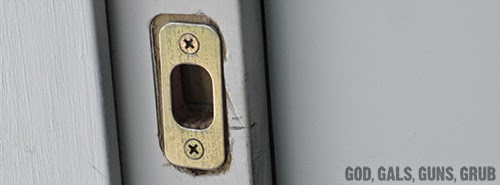
Most residential doors, even "steel" entry doors, are very weak compared to commercial steel doors in many commercial buildings. The key areas of weakness are primarily found in the hinge attachment points and the locking points on each side of the door. Most residential doors, even "steel" doors are just a thin steel or laminate covering over a wood particle or even foam and wood core. Here you can see a typical locking plate for a deadbolt lock for a "steel" entry door as it comes in the door frame from a lock big box home improvement center:


There is barely a three-quarter of an inch thick pine or poplar wood door frame/jamb holding the locking plate for the "steel" entry door.


This area typically breaks right out and splinters when the door is "kicked" in.


The easiest and cheapest door reinforcement you can do is replace the standard three-quarter-inch or one-inch screws holding the hinges and locking plates in place with two to three-inch long screws that go through the door frame/jamb and into the two-by-four or two-by-six wall studs that frame the doorway.


An additional step would be adding a heavy-duty lock plate with longer screws.  The heavier gauge steel lock plate with four long screws securing it to the studs behind the jamb will hold far better than the thin door jamb by itself.


The most thorough reinforcement of existing doors would probably the installation of a kit such as a Door Devil or EZ Armor by Armor Concepts.  If you have a door that has already been kicked in, if most of the damage is just the door jamb being broken out, many of these types of kits can be used to repair and reinforce your existing door.

Again, these tips will not prevent a door from being kicked in or being breached, but it will help buy you time and slow down many bad guys. If you are in the process of new construction, there are many other steps and purchasing choices you can make to have stronger, more fortified doors. but for now, the gals and I hope this helps you with... Keeping your doors closed...

Monday, January 6, 2014

Four ways home...

While folks who do much prepping at all have most of their preps at home... you may someday be faced with having to get home.  Every day there is a chance you might find yourself at work, store, school, church, a friend's house, or somewhere else you frequently or occasionally travel to and you need to get home.  Ninety-nine out of a hundred times, that is not a problem... but there is always that time that arises when getting home and be difficult, delayed, or impossible.

Are you prepared to make it home? Do you have a Get-Home-Bag (GHB) or Bug-Out-Bag (BOB) with you? Do you have multiple plans and routes to get home in case of bad weather, an accident, road construction, or other unforeseen disaster or problem?


Let's talk about four ways home the the gals and I have prepared for and see if it's helpful for you to consider for your situation:

The Rut

Many years ago, after completing a patrol tactics seminar that challenged law enforcement officers to examine and break out of predictable routines... I went in the "exit" road to patrol through a cemetery in our jurisdiction lookin' for the usual suspects... like kids drinking, young lovers, tokers... and then... I saw it! I had always gone into the cemetery through the "enter" access road and there was a tombstone that had the quote, "See you on the other side."... and when I went in through the "exit" road... and came up on that tombstone... on the back side it simply said, "Hi there."  Now THAT is a guy who literally took his humor to the grave.

The Rut is the route, manner, and mode of transportation that most of take to and from our destinations like work, the gym, the kid's dance studio, and the store almost every single time without really thinking about it. It is often the quickest and easiest way to there and back home again. We often develop these "Rut" routes without really a lot of strategic thinking or evaluation and then use them over again.
"It's pretty far, but it doesn't seem like it." ~Yogi Berra
Should we abandon The Rut? No... but you should recognize that The Rut becomes routine, makes you predictable in your movements, and leaves you vulnerable because you tend to drop your alertness and become passive in your travels.

Maybe you need to re-examine The Ruts in your daily life and see if there are more efficient, strategic, or less predictable ways to travel from home and back again.

The Back-Road

If some of us do have an alternative to The Rut, it is often The Back-Road way to get home... and if you don't have an alternative to The Rut, The Back-Road should be your first approach. Most folks take major highways or thoroughfares from home to their destinations and back again.  What if an accident has those routes closed?  What if there's a major snow storm or other problem that shuts them down?


This is where you need to become familiar with the secondary, country roads, and back alleys around your home, destination, and in-between. Take the time to turn off the GPS, get out a map and sometimes just drive. The GPS will often try to guide you back to the main highways and shortest route. I've seen too many people blindly following the GPS without really paying attention... just turning and going wherever the dashboard teleprompter tells them to go.
"When you arrive at a fork in the road, take it." ~Yogi Berra
Can you make it from work in the city to home in the suburb or country without using the main highways and major roads in your area?  If your map reading skills are getting rusty... it's time to dust them off and plan out a few back-road ways home to try... and adjust... and who knows, you might even find some really cool out-of-the-way places you weren't aware of in your area. You should have a good road atlas and maps in your vehicle and your GHBs and/or BOBs, but don't forget to pick up a good, detailed, street-level map for your more immediate area that shows all those back-roads in detail. They will also come in handy when you have a detour or delay on The Rut.

The Round-A-Bout

Sometimes you just can't get there from here.  I have a good friend who drives over an hour to work in Columbus every day.  His rut is Interstate 71. A couple of years ago we had a bad winter storm and there was a pile-up on 71 and the Ohio State Patrol had the entire southbound interstate shutdown. The rapidly accumulating snow would like make The Back-Road way home very slow and difficult as those roads are often the last to be cleared and tend to drift over quickly with our southwest Ohio winds.
"If you don't know where you are going, you might wind up someplace else." ~Yogi Berra
The solution was not provided by the GPS. He took Interstate 70 west towards Dayton and then ended up cutting south on U.S. 68 to make it home. A bit farther to go, but far quicker than waiting on 71 to be cleared of the pile-up and better than chancing the smaller back-roads not being in very good shape.


What's your round-a-bout way of getting home?  Have you thought about it? Get out the map and when you can't head south to get home, how can you get there by starting off east or west, or even north.

The Long Walk

You may find yourself in the very unfortunate situation of having to walk home when you normally drive or ride home. Always keep a good set of walking shoes with you in your GHB, BOB, vehicle, or at work.

Walking down the interstate is probably not going to be an option unless it's the Zombie Apocalypse. Your back-road route might work, but may not be ideal either. Is home within walking distance given your physical abilities? Do you need an alternative location to walk to? Do you have friends or people within walking distance that you can rely on?
"It gets late early out there." ~Yogi Berra
If you do have to "hoof-it" on foot, take with you what you can, think ahead about the weather, hydration and water needs, etc. If you're leaving for home on foot at the same time you would typically leave in a vehicle, you know it's going to take a lot longer to get home so plan accordingly.

Some tips that may help...

Lose the GPS and tune up your map reading skills. Don't have a map? Get one! Take some time to explore the areas around your home, work, school, destinations, and everything in-between.

Plan for unexpected delays. If you typically use 2,000 gallons of gasoline each year in your vehicle, you will not likely use and more or less if you fill your gas tank up when it still has a quarter of a tank of gas left than when it is on empty. Do the math, it works out the same.

Always keep water, supplies, and a GHB or BOB in your vehicle. Have you checked the air pressure in your spare tire since you've owned your vehicle?  Is your vehicle's maintenance up-to-date? Have a working flashlight? Two? Three? Ok, I'm a flashlight nut... what can I say.

Finally, at least one day each week... a different day each week... don't use The Rut in your daily travels.

This post has been on my to-do list for a while, but with the pending snow storm and sub-zero temperatures predicted for the next couple of days around here... it seemed like a good time to start thinking about... Four ways home...

Sunday, November 3, 2013

First Shots Cold... Preparing for cold weather.

First Shots Cold... I think this may be an occasional, re-occurring theme.  As an instructor, I think one of my greatest assets is that I'm a life-long learner, an eternal student. As a shooter, I'm just an every-day, middle-aged, sub-height-for-weight-specs, guy... who is practical, realistic... a husband, a father, a friend, a neighbor. I'm not an operator, a tactical ninja, an urban warrior.

That doesn't mean that I'm not a proficient shooter. As an every day guy who carries a firearm for self-defense, I want to be sure that I can defend myself when the time comes. I am actively losing weight, exercising, weight-lifting, and watching my diet... but ultimately, the firearm gives proficient shooters a defensive advantage to a threat of death or serious bodily harm regardless of your physical condition when compared with going unarmed.


With that in mind, and with winter approaching... I have been practicing with layered clothing and heavy outerwear to get ready for the season of cold that is quickly approaching.  In the photo above, I'm wearing multiple layers including thermal underwear - top and bottom, for a total of four layers of upper body clothing and two layers of lower body clothing, hence the over-sized pants to tuck in some of the upper layers.

I prefer layered clothing in the winter so I can adjust my insulation level as I heat up or cool down with my activities. The layers create several concealed carry considerations. I can consistently draw from concealment and place a shot on target in under two-seconds at twenty-five feet in regular clothing for summer wear, but I'm slower in the winter with either my layered clothing or just a heavier coat or jacket like my parka. First, the belt is not as secure in it's position around my waist when on top of three, four, or six or more layers... and second, the layers mean I have more to deal with when accessing and drawing my firearm.  This makes a good, stiff carry-belt even more important.  


So how does this all relate to first shots fired? I practice often, usually using a timer for various drills, but the drill and time I'm most interested in are my first shots fired. Each time I go out back to the range and set up to practice... I get my timer out, I set it for a random start delay, and at twenty-five feet I draw from concealment and fire. THAT is the time and accuracy measure that I ultimately use to assess myself. 

Sure, I can drill and practice and drill and practice and see what my best time is... I often do that. I can game the scenario with a shoot-me-first vest and an OWB holster practicing for IDPA, but ultimately... I want to be able to draw from my concealed Comp-Tac MTAC holster with my every-day-carry Ruger SR9 or SR9c and put a center-of-mass hit on target at twenty-five feet, in my every-day clothing in under two-seconds.  Hence, I test myself when I take my first shots on the range by timing my first shots fired from concealment.

Winter clothing choices can really hinder your access to your firearm. While I usually carry on my strong-side hip, I will often switch to strong-side appendix carry with heavy winter coats and jackets. I like a winter jacket that has Velcro closures in addition to a zipper, because I can leave it un-zipped and just Velcro-ed closed for a quick, rip-n-access draw.

So... as the seasons change and your clothing choices grow heavier and more layered... make sure you're practicing... and ready for those First Shots Cold... Preparing for cold weather.


Sunday, October 27, 2013

It's in my blood... American Exceptionalism.

I may be one of the few that's left... a shrinking minority... a man who still believes that the United States of America is exceptional. My friend, Matt, over at Jerking the Trigger recently posted a link to a video of Greg Medford speaking at a gathering of employees and friends at Medford Knife and Tool. It reminded me of why America is still exceptional... because we are more than just a geographically defined land mass... we are a group of diverse people who live in a nation founded by a Declaration of Independence and on a Constitution that spells out and protects the rights of man given by God, our creator. Sadly, I believe many folks have forgotten where we came from, how we got here, and where we should be heading.

Pappy, my brother, and... me.
My great grandfather had five boys who grew up on the farm. They made their own way, worked through the tough times of the Great Depression farming, selling milk, building homes, doing various jobs as necessary and as they could. They took care of their family, their friends, their community, and their country. Some served in World War II while folks like my grandfather farmed and worked in the steel mills along the Ohio River to help produce the raw material that continued to build our country.


I have great memories of my grandfather, "Pappy" as everyone called him.  Maybe those memories are inflated, almost legendary in my recollection, but he was a good man, a strong man, a manly man. He worked hard... in fact I'm not sure he knew how to not work hard. Ask anyone who's had dairy cows about getting up every morning, working every day in a labor intensive job, then working each night to keep the farm going. He could make, fix, or build just about anything... and he and my grandmother gardened, butchered beef, and provided for most of their own needs.


He still found time to have fun and do things with his family, friends, and grand-kids. I think I tend to live a lot like he did... I saw it in my mother too... a hard working lady who could cook, sew, and change a disposal under the sink or build just about anything she set her mind to. She put herself through college, married, and had two boys of her own, still working daily tutoring math as a volunteer in our local schools at almost eighty years of age. She can't stop past our house without doing some kind of work around here. Heck, we almost have to have some odd job lined up for her or she won't stay to visit very long.


The gals and I are pretty self-sufficient and can do just about anything we set our minds to and if we can't figure it our or have the right equipment... we have good friends and neighbors who probably have what we don't... so we help each other out like friends and neighbors should.  That is something that's not lost out here in the country.  I know my neighbors that live a half-mile away better than a lot of city and suburban folks know their neighbors that live forty-feet away from them.


Folks, we're headed for some rough times ahead... there's know doubt about it. We can't borrow our way out of it forever and at some point it's going to come down to fending for yourselves, your families, your friends, your community, and your country. I don't think endless growth is sustainable and while we may not have a total collapse... I believe we're at least heading for a "constriction" of our country's economy and general life-style. It's time to skip a few soccer games, occasionally turn off the TV and Facebook, and spend some quality time with the ones you love... building skills, knowledge, capabilities, supplies, and relationships that are real, practical, and meaningful.


We may not be as exceptional as we once were, but we have the foundation to be more exceptional than any place else on earth... if folks are willing to step up, take personal responsibility for themselves and their families, acknowledge reality, and move forward... looking towards a future.  THAT is why places like Medford Knife and Tool are prospering in tough times... that is why Pappy's legacy lives on generations later... and that is why my gals and I will do fairly well no matter what our circumstances are. We're not invested in and our worth is not found in things, but in folks.

What can I say... It's in my blood... American Exceptionalism.

Friday, June 7, 2013

CYA: Cover Your Ass... ets!

This is a topic I began to write about quite some time ago, but I was recently reminded by a post over at A Girl and Her Gun after a friend of hers lost most of what they had in a house fire. The risk of losing our assets, whether they be our firearms, prepping supplies, or other property is always a concern. Most folks have insurance on their home and vehicles, but often they don't have adequate insurance or security measures in place for other assets.


We experienced a burglary of our barn several years ago by a fairly professional crew. They were hitting out-buildings such as barns, sheds, and un-attached garages specifically taking dirt bikes, generators, compressors, construction grade tools, etc. They would come in on foot, hit several places in an area over about sixty minutes, set the items they wanted outside, usually to the rear of the buildings... then they'd come back fast and hard in four-wheel drive trucks driving up, throwing the loot in the back and taking off. They hit us and nine other places on a cold, windy, ten-degree night in December between one and three in the morning.

We lost three Yamaha dirt bikes in terrific condition as they were only used for trail riding and our good 18-volt power tools. They mus have had too much loot from the neighbors since they left one of our generators sitting in the yard near the barn. We carry a thousand dollar deductible on our home-owners insurance we had to eat the loss of $800 plus in tools. The motorcycles were insured, but three dirt bikes minus $500 deductible each, minus depreciation - which is significant per the "blue-book" for dirt bikes... we lost $12,000 in dirt bikes and promptly received a check for $4,600 from our insurance company. We also spent/invested $800 in extending our home alarm and security system to the barn afterwards. The neighbors up the road lost a four-wheel ATV, but did not have separate coverage and since it is a separately insurable item, their home-owners did not cover it.


So, how to you handle your risk of losing some of or all that you have? Well, isn't that why we carry conncealed or prep in the first place... to minimize and mitigate our risk to adverse conditions or circumstances? First, you have to understand that you can NEVER eliminate risk or loss, only mitigate or reduce it's possibility or impact. We are not perfect at it and have been working on it for years, but here are some considerations for you:

Don't keep all your eggs in once basket.

We have well over one-hundred firearms... but only about half are in our fire-resistant gun safe. Some are stored in readily accessible places, some are stored in caches both on and off our property, some are kept off-site under other circumstances. I think a quality, fire-resistant, and tamper-proof gun safe is one of the best investments you can make. Make sure it's bolted down and not in plain sight.  If you can see your safe in the back of your garage from the road while the garage door is open, you're just inviting thieves. Maybe you just need basic security of your firearms to keep them from young children.


Many of you live in states where if you lost your firearms or full-capacity magazines to fire or a thief, you couldn't legally buy or replace them right now assuming you could even find them in-stock under the current circumstances. Also, if everything you own is in your home... you're just one fire or tornado away from losing everything. Do you have a trusted friend or relative to store some items at an off-site location?  Do you have a safe and secure cache location? Don't get me wrong, a house loss due to weather or fire would be devastating to us, but we won't be without access to firearms and ammo and supplies if it happens.


While most of our preps and supplies are stored here at home - including our main Bug-Out-Bags, we have Get-Home-Bags and supplies stored elsewhere too. We had to make a recent change last year to some off-site storage as my mother sold her home and moved to a retirement community. Even our computers have off-site back-ups. We back-up all the computers the first Saturday of each month to two Tera-Byte portable hard-drives that are encrypted and require a password to access.

Layers of security where two is one and one is none.

Your security should be in multiple layers as there is no one, single thing that will eliminate (which can't be done) or minimize most of your risk of loss. Consider your location and environment.  Someone in a high-risk urban environment will have different considerations than someone in a suburban situation or those of you like us that live out in very rural areas. We have multiple complimentary and stand alone layers in place and they still will not eliminate all problems or concerns.


We keep our home closed up most days. You can't see what's in our garage or barn when the doors are closed. Friends who are not neighbors, but pass by fairly regularly often comment that they'd stop in, but they never know if anyone is home. We have bushes planted in front of ground level windows to make physical access more difficult. We have an alarm system with visible notification and multiple, large internal and external sirens to deter those who breach our home's (and now our barn's) alarm system. The alarm system is cellular and runs off battery back-up units for up to a week. So, cut our phone line and nothing happens.


We have two larger dogs that are alert and bark at strange and unusual activity. We keep our doors locked when we are at home. Our doors have had both the hinges, dead-bolts, and jambs reinforced, but I'm sure they can still be breached by determined folks... although it won't be an easy one-kick access. Our locks are pick-able - as most standard household locks are - as I've picked them all, but many don't have those skillsets and the cost to upgrade locks is not in the current budget right now, but it's in the long-term plans.


Many items are hidden in plain sight. We do not have a basement, so our main gun safe is in the kitchen.  It dwarfs our refrigerator, but from the front door, it looks like a refrigerator and most do not realize it is there unless they are welcomed into our home and then into our kitchen.  The safe is also bolted to the wall and floor with some specially built support and anchoring structure in the crawl space.  We store some documents and cash in a portable, fire-resistant box that is then stored in the gun safe, but... if you want the majority of our cash or other valuables... you won't find them there.  They are not in the house... or the barn. We also have our food preps divided up. Some friends of ours lost most of their food preps last year when their basement flooded with over six-feet of water while they were on spring break vacation for two weeks.


We have other security measures, alerts, processes, and hindrances in place, but I will not discuss them here. You each need to access your situations, educate yourselves, and make some determinations of plans, provisions, and tactics for your family and home. We can suffer loss, but it's highly unlikely we will lose everything if we lose our home.

OPSEC because loose lips sink ships.

We are probably not the best at Operational Security, or OPSEC. I'm an NRA, CCW, and 4H Shooting Sports instructor. I participate in hunting, Skeet, Trap, Three-Gun, 4H, IDPA, and other shooting activities regularly. There are hundreds of folks that know we have guns... that we have multiple guns. We are active in our community through church, the schools, 4H, and other activities... therefore many folks know where we live and what vehicles we drive. Our mail carrier sees the mail and magazines that arrive each month. Even my UPS and FedEx drivers know about us by the shipments that arrive and the vendors we use. I'm sure it wouldn't even take you very long to figure out who I am through my blog.


With that being said, there is still a lot of information about us, our property, and our lives that are not known to many. My daughter has been raised from a young age to guard her speech and that there are things we discuss and do in the house that are not discussed or done outside the home.  We try not to be creatures of habit, although everyone is to some extent. We even practice systematic dis-information because we are known by so many. Our jobs allow us flexibility to leave and arrive at different times during the week and on weekends... even though the best time to hit our place is probably Sunday mornings as that time away doesn't change each week... except our neighbors are friends and know to watch the place on Sunday mornings.

All that being said, you need to be aware of how easily most of us can be profiled and tracked by amateurs and criminals. Break up your habits. Do you know at least three routes to get from home to work and back... and do you use all three regularly and randomly throw off those who might be watching? Do you know who your neighbors are? Do you know who that new guy at the IDPA match is that you just bragged about your seven Glocks to? Think about what you say and who you say it to if you want to minimize your risk of loss.

No problem, it's insured.

Most folks, in my humble opinion, A) do not understand the purpose of insurance, and B) do not have adequate or appropriate insurance. Insurance will not bring back, replace, or cover one-hundred percent of what you lose. Never has, never will.

First, you need to self-insure you, your family, and your property... to some extent. That may be cash on-hand, it may be extra firearms or supplies, it may be two instead of one. We have a one-thousand dollar deductible on our home-owner insurance. We have five-hundred dollar deductibles on our vehicles. That means we are self-insuring for the deductibles. Why not have lower deductibles? Well, it costs more money... and... go ahead and pay for the $250 or $500 deductible on your home-owner insurance... about the third claim you make... you will pay for it dearly in your premium or you might be altogether dropped by the company as it's happened to many family and friends over the years who think insurance is for every oops they have.

Second, you need to read your policies, ask your insurance providers, and know specifically what is and is not covered and how much the coverage is.  We had to change home-owner insurance companies when we added our German Shepherd Dog to the family as Grange Insurance does not cover them... period... you can't even buy a rider. Most home-owner policies cover firearms for loss by something like fire, but are typically limited to $2,500 or so for theft... the same for jewelry and precious metals, etc. You can often add a rider to cover firearms and such, but read the fine print.  You might have to list your firearms... you may not. The NRA endorsed program only requires firearms and accessories over $2,500 in individual item value to be listed... but the NRA endorsed policy doesn't cover theft of your firearm from you vehicle if there is no breaking and entering of your vehicle... meaning if you left it unlocked... tough luck.

Often, separately isurable items are not covered by home-owners or renters policies. An ATV is separately insurable for most companies, so it is not covered. Now, our John Deere diesel tractor is used for up-keep of the property, so it is covered, but we increased our home-owner property covereage to adequately cover it and other equipment we have... and if you use ANYTHING for business purposes... like the zero-turn mower you mow your lawn with and use for your part-time business... your home-owner policy will not cover it.

Also, make sure you understand what is not covered. Sometimes perishable food items are covered, sometimes not. Three years ago we had friend who lost power at their home for three days in the summer and claimed $1,900 worth of food from their freezers since they had a $2,500 perishable food claim limit, but that was their second claim in five years and their annual premiums went up almost $380 a year after a claim to cover $1,500 of food (remember, they self-insured for the first $500 with their $500 deductible).

Finally, remember... you can sue anyone for anything at any time. The suit may or may not succeed, but defending yourself and pay any awards or judgements can riun you for a life-time.  Consider additional issuance as your situation dictates. My wife is a teacher, she had liability insurance through the Ohio Education Association. We have an umbrella policy on top of our home-owner policy for liability. I have NRA endorsed insurance as an instructor. We have additional insurance on our firearms through a separate company. We increased our content coverage on our home-owner policy due to our preps which covers items stored on-site and off-site... within the State of Ohio... read those policies!

The gals and I are not the experts on these matter, but like the God, Gals, Guns, Grub motto says, "We're learning a little more every day."

If you have something to add or educate folks about... please do so in the comments... so you can also help good folks with... CYA: Cover your Ass... ets!