Showing posts with label Prepping. Show all posts

Monday, April 8, 2019

Every Day Preparedness for Regular Folks: The Dorcy LED Mini Lantern...

Sometimes inexpensive is cheap... and sometimes inexpensive is good enough. Good enough is right where the Dorcy LED Mini Lantern falls in providing a good, portable, and affordable light source for regular folks during a power outage, while camping, or just for temporary small-area lighting.


The Dorcy LED Mini Lantern operates on four AA batteries and the manufacturer claims they will run for 70 hours on a set of alkaline AA batteries. The gals and I tested one of our lanterns with a brand new set of Amazon Basics AA alkaline batteries and while the lantern's LEDs did dim down a bit at the end... they lasted just over 76 hours!

They don't even list the lumens for the four little 5mm LED bulbs that light this lantern, but these lanterns are not meant to light up a 400-yard perimeter at the bug-out compound. What they do well is lighting up areas of your home during a power outage or a tent while camping. A hook is built into the carry handle and folds out to hang the lantern in your tent, or from many things as the lanterns don't weigh much at all.


In the photo above taken with the iPhone... you can see that it throws a nice, even white light for 360 degrees around the lantern. We've even knocked one of ours off the kitchen table... it hit the hard floor and bounced a couple of times, but never broke.

There are better, brighter, and more rugged products out there like the Streamlight Siege X, but when you can pick up one of these for under six-bucks... or a three-pack with batteries for under seventeen-bucks at Amazon... they're easy on the budget. We've had a couple of these lanterns for over two years now... and recently picked up a couple more. They were worth every penny this winter during a two-day power outage.

So... our recommendation for Every Day Preparedness for Regular Folks: The Dorcy LED Mini Lantern...

Sunday, March 12, 2017

Daylight Savings Time... our semi-annual readiness check.

Well, I'm still looking for that hour I lost last night, but we should get it back next fall. Twice a year... here in Ohio... we change our clocks for Daylight Savings Time. While the advantages gained are debatable... it's our semi-annual reminder to check our stuff. What stuff you ask, well... a lot of stuff... it's been a busy day(s)!


First off, this weekend we shot our Every Day Carry (EDC) ammunition and replaced it with new.  This has been discussed in the past with "Five reasons to shoot your Every-Day-Carry Self-Defense ammunition!" It's also a good time to check your cartridges for any set-back you might be experiencing.  We rotate the round we chamber each time and haven't really experienced a problem with bullet set-back in the cartridge because we don't re-chamber the exact same round over and over and over every single day.

We also do a lot of other checking this weekend. We check our Bug Out Bags (BOBs) and Get Home Bags (GHBs). We update anything that needs it, rotate out expired provisions if necessary, and add in anything else we've decided to at that time.

We also check batteries... and replace if necessary... in radios, flashlights, weapon lights, red-dot optics and other devices well beyond the typical smoke alarms and carbon monoxide detectors found in most homes. The portable generators are started and checked... annual maintenance like oil changes, etc. happens each fall when the clocks change.

Have you checked your vehicles over... checked the air pressure in all five tires...yes five... that spare won't help if it's flat too. How about your prepping supplies... food stores... like the pantry to make sure any close to expiring goods are moved up front in the rotation and expired goods are discarded. Medical supplies and medicines are also checked, updated, and/or discarded as needed.

How about some personal identity security? We're no cyber saints around here, but we do update our passwords on all our accounts at least twice each year... when the clocks change.

The list could go on and on... and it takes us several days to go through everything... and that's why we actually have a checklist... you should too... and maybe you should do like us... because we make... Daylight Savings Time... our semi-annual readiness check.

Tuesday, December 15, 2015

We live with guns...

Our dogs are part of our family. I've always said that we don't own them, we live with them. They live in our home and our lives fully.  Recently, our friend Melody Lauer made a comment on Facebook about living with guns. Our family is the same with guns, they are an integral part of our everyday lives for self-defense, fun, sport, hobbies, reading, learning... just about whatever.


The one gun safe is in our kitchen right next to the refrigerator. We tend to be in and out of both the refrigerator and gun safe twenty-four-seven. Heading out to the barn, grab a bottle of cold water and an AR in case a coyote decides to get within range. Heading out to the shooting range out back, grab a shotgun, an extra couple of mags... and hmmm... haven't shot the gal's Smith & Wesson 9mm Shield in a while... let's grab that. Maybe that Glock 19 would go better with the gal's outfit today. Heading to 4H Shooting Sports, grab a few guns to take along like that Ruger MKII Government Target model and that Ruger 22/45 Target model.

Our daughter grew up living with guns and she was taught safety and shooting fundamentals early on and the idea of living with guns keeps us always in the mode of safety, mindset, and where our guns are at any given time... and they're not always in the safe... we carry around home too. We're actively involved as firearms instructors and in shooting sports, hunting, and just about anything that involves shooting... it's just our "thing". Truth be told, there's usually not many places we are in our lives.. home, vehicle, barn, or out and about... that there isn't a gun handy.

Now I know a lot of people own guns. They have that shotgun they get out for hunting every fall or the gun that "gramps" passed down to the family or that pistol bought for home protection that hasn't been fired in three... err... six... uhh... seven years. So, maybe a question you might think about... Do you own -or- do you live with guns?

We live with guns...

Sunday, November 15, 2015

Over 18,500 rounds through a Ruger SR9...

To admit my bias up-front, most people who know me know I love all things Ruger. Ruger is an innovative (especially in manufacturing), debt-free company that produces American-made guns made by hard-working Americans... and that's something that has always appealed to me.  Now, as a firearms instructor, I often recommend to my students that want a self-defense or concealed carry pistol, that it's hard to beat a Glock or S&W M&P... but for me and also budget-conscious people... it's hard to beat the quality and reliability of most Ruger products in any given category.


That budget concern is one of many factors that led my family to select the Ruger SR9 and SR9c pistols for home defense and concealed carry because I wasn't just purchasing one pistol, we were purchasing three pistols. It was a pistol, at the time back in 2008, that was very slender in the grip and seemed to fit the hands fairly well for my wife, my daughter, and me. We were looking for a standardized gun for the family that would work well for self-defense, plinking, IPDA, and concealed carry, while allowing magazine interchangeability between family members, having common parts to keep on hand, and even holsters too.

Some of our Ruger SR9's - we have a number of them - were purchased through Ruger's Instructor Purchase Program and are used in the firearm courses and 4H Shooting Sports that I instruct. One particular Ruger SR9 we purchased in 2009 became my "endurance-quality" test gun. I wanted to see what problems we'd encounter over time.

We started with Todd Green's 2000-round Challenge back in 2011.  I took this new SR9 right out of the box, visually inspected it, but did not clean it... and finally after 2,618 rounds fired... we had a stove-pipe on round 2,619! The gun needed cleaning... badly. We had only had three prior failures during those 2,618 rounds due to ammo not firing with clear, deep primer strikes using Winchester White-Box and Federal 115 grain FMJ ammo we had used.


Now, this particular gun has been our primary practice gun (we do shoot the others regularly) and I decided that I wanted to see what would break or wear-down first on this gun since my entire family is betting our lives on the Ruger SR9 series. The gun was regularly cleaned and maintained after that first 2,619 rounds and just passed 18,500 rounds fired this past weekend.  It did go back to Ruger once after 12,200 rounds to replace a Striker Spring Cup that had cracked (Part #25 in the Ruger SR9 Manual)... which Ruger took care of at no cost... although they probably had no idea how many rounds had been through the gun.


So... here we are, well-past 18,500 rounds fired with many brands of ammunition and 9mm variations... still with the original springs in the gun and magazines. There is definitely wear showing on areas of the barrel and inside the slide, but not so much we're concerned and it still holds tight groups. Yes we've had failure to fire and other malfunctions mostly due to ammunition problems or students limp-wristing on occasion, but the over-all, steady reliability of this gun gives us complete confidence in these pistols. Hopefully, we'll pass 20,000 rounds this winter and keep on going... as I'm curious as to how long the springs will last providing reliable cycling.

I remember three years ago when my wife, daughter and I showed up at the Tactical Defense Institute's Defensive Pistol Levels 1, 2, and 3 with our Ruger SR9's as part of my daughter's high school graduation present. We were told they never saw a Ruger SR9 make it through the three-day, high-round-count course without failing. Well, two of the three Ruger SR9's we brought with us did fine with over 1,300 rounds through each of them, but one started to have light primer strikes on day three after about 900 rounds... mostly due to being gunked-up with residue from over-oiling by my daughter. Lesson in lubrication learned! Oh, and by the way... we also saw Glocks, M&P's, Sig's, F&N's and many other pistols malfunction during that course.

So, while we do own a number of Glocks and S&W M&P's, along with other pistols and brands... our Rugers are still our go-to guns for the most part... and I tune-up/re-build most of them every 3,000 to 4,000 rounds... we feel pretty good about our choice for many reasons, including... Over 18,500 rounds through a Ruger SR9...

How have your experiences been with the Ruger SR9 series?

Sunday, November 8, 2015

Blinded by the light... shining in YOUR face!

As I drove up the long lane to the house, the lights of a vehicle suddenly came on and momentarily blinded me. I quickly stopped the cruiser about a hundred yards from the other vehicle just as my eyes adjusted and the silhouette of a man with a shotgun stepped in front of the lights. Grabbing my pistol with one hand and the handle of the spotlight with the other, I lit him up... with the spotlight... it was the farmer who called in the prowler he saw behind his house. That was more than two decades ago, but it taught me early on and reminded me quickly that as much as we were instructed and trained about the temporary blinding effects of unexpectedly shining our flashlights or spotlights on a suspect... the same could happen to us.


As close as I can recall from my memory and records, I've completed nine different training opportunities as a police officer or regular citizen over the years that either included a component of shooting in low-light or at night or were focused specifically on that type of shooting or self-defense situation. I've even participated in two force-on-force courses that involved low-light scenarios. The idea that a flashlight or other light might be shining back at me was never even discussed in any of these training courses or opportunities.

As much as we were taught the importance of clearly identifying our potential threats and targets and instructed on the many techniques for shooting in low-light while using a flashlight, tactical light or weapon light... none of those courses ever dealt with encountering a person or aggressor shining a light back at you... in your face... temporarily blinding you. I asked a friend about it who is a recently retired LEO with many years of Special Response Team experience... and he said he had never seen that situation presented in training even though he had encountered it while on duty several times over the years.

If you were to base your assumptions about possible encounters with aggressors or criminals... or even neighbors... at night or in low-light situations based upon much of the training currently offered or that most people receive... YOU are apparently the only one that brings a light with you into a low-light or dark situation. I would hazard a guess... that if you encounter someone, there is the distinct possibility they will have a light with them, even if it's just the one on their iPhone. The basic low-light course I teach incorporates a number of different scenarios to help train people using a tactical light to clearly, accurately, and quickly identify and confirm a possible threat. One scenario I have my students try is confronting a target that shines a flashlight back in their face.

Positively identifying people and whether or not they pose a threat in low-light or dark situations is a difficult task that requires the proper mindset, tools, training, and practice to do well... but encountering a light shining back in your face can really make that process difficult by temporarily blinding you. Even a low-power flashlight like the the cheap ones I use in various scenarios on the shooting range, like in the photo above, can temporarily cause all else to go black as the light blinds you, your eyes try to adjust, and your OODA loop becomes O...O...O...O.

It's a really tough situation to be in, but it's not an unlikely situation. Maybe it's a burglar who brought a flashlight with him. Maybe it's a neighbor with a spotlight you encounter in the back yard who heard the same "bump in the night" that you're investigating. Maybe it's the lights of another vehicle or porch lights that jut came on. There is a strong possibility that you will sometime find yourself staring into a blinding light that diminishes your visual sight to identify potential threats.

This situation presents a number of problems for anyone interested in self-defense as darkness seems to come around about once a day and lasts several hours.  If someone "lights you up" in the dark, you need to make quick decisions. Can you quickly get back behind cover or concealment? Are you in the middle of the yard or a garage where you have no readily available cover or concealment? If you shine your light on them, can you see well enough to identify them and if the pose a threat?

Here's a couple of thoughts to consider. Try to not look directly at the light, but don't look completely away either, and scan around the light to determine where the person is in relation to the light. Also, you can shine your light back at them putting them in the same disadvantaged situation. Either way, this is a tough situation to be in. Fortunately for us, we have a private range where we can practice these low-light situations.  If you don't have access to a range that allows low-light shooting, you might try incorporating it into your practice at home with either your dry-fire practice (try lighting yourself up in a mirror) or consider role-play (not using your real gun) in your home with family members playing the other person or intruder with a light shining back at you.

So... have you trained... practiced... or visualized what you're going to do... when you're...

Blinded by the light... shining in YOUR face!

Note: If any of you have been to training that addresses this situation in the classroom or on the shooting range... let me know when and where and who... I'd love to sharpen my iron with other instructors or training opportunities...


Sunday, November 1, 2015

Five reasons to shoot your Every-Day-Carry Self-Defense ammunition!

Like everyone else in a time zone that follows Daylight Savings Time... we set our clocks back an hour last night and enjoyed an extra hour of sleep. This also begins a semi-annual ritual we have in our "prepping" mindset of checking, changing, updating, and discarding items to keep our "tools" in top shape, ready for use.

Many things are checked over and refreshed. Flashlights get new batteries and the old batteries are rotated out to more mundane tasks such as powering television remotes or toys... fresh, stabilized gasoline is put in the generators with the old going into the vehicles... and most importantly... we practice out back on the range, shooting our chosen self-defense ammunition that has been carried daily since the last time the clocks were reset.


As a life-long shooter... former law enforcement officer... a long-time firearms instructor... and a daily concealed carrier... I am always amazed at the number of people I meet who have either never shot their self-defense ammunition or have been carrying around the same self-defense rounds in their firearms for years... even more than a decades! The most consistent excuse I hear is, "Do you have any idea how much that ammo costs?" Apparently it costs just a bit more than what your life is worth.

Everyone has to make their own choices. As a general rule of thumb... I don't carry a gun until I'm comfortable with it's reliability, particularly with the self-defense ammunition I've selected.  For me, that means at least 500 rounds fired reliably through a gun with at least 100 rounds of that being the self-defense ammunition I've chosen. That way I know the ammunition works when I need it to.

So with that being said, here are five reason you should shoot your Every-Day-Carry Self-Defense ammunition at least twice each year:
  1. It confirms your firearm functions reliably with that particular ammunition.
  2. It acclimates you to the the "feel" of firing that ammunition - including sound, muzzle-flash, and recoil - which may be substantially different than the inexpensive practice ammunition you use on the range.
  3. It keeps the ammunition in your daily-carried self-defense firearm - that has likely been exposed to heat, cold, humidity, moisture, sweat, or other contaminants - fresh and reliable.
  4. It forces you to practice. For some of you, if we're being completely honest here, it may be the only two times each year that you actually fire your gun and twice a year is better than none.
  5. It reminds you to check your firearm over and clean or lubricate it as necessary.
Some of you may have other thoughts on how often or why to shoot your daily carry self-defense ammunition... but I think you'll agree that twice a year is budget-friendly enough for most people who don't shoot it due to the replacement cost. If nothing else, I hope you'll agree that these are...

Five reasons to shoot your Every-Day-Carry Self-Defense ammunition!

Friday, June 26, 2015

Six Self-Defense Commands and Strategies for Families…

Every parent wants to protect their family, children, and loved ones… but few have actually taken the time to plan, prepare, and practice for emergencies and violent encounters with their families. Now please understand that preparing for the possible is not the same as being paralyzed by paranoia. You don’t have to scare your family to death or force your significant other or children into actions or areas they are not comfortable with... but taking a practical, thoughtful approach will allow you to implement some basic commands and strategies for you, your family, and loved ones to use in case of an emergency.

I really began thinking strategically about incorporating the entire family and household into the process back in the 1980s and 1990s when I worked in law enforcement… and especially about age appropriate commands and strategies when my daughter was born in 1995. My elementary teaching wife has been a terrific asset in applying age appropriate pedagogy and strategies... and over fifteen years of teaching shooting sports to 4H youth ages 8 to 18 has really helped me understand the capabilities and limitations of what you can expect from kids.

John Correia over at Active Self Protection occasionally has good video analysis of self-defense situations involving families and children over at Active Self Protection… and my friend, Melody Lauer, has really created some positive buzz with her baby-wearing and carrying self-defense classes. While there has been occasional mention of integrating families, loved ones, and especially children into self-defense planning here and there by the "big name" trainers and schools… there is still not a lot of quality, in-depth information or instructional opportunities out there on these matters for average people… so I intend to begin sharing my experiences and thoughts here on the blog… at least to start some discussion and continue my learning, if not your learning, in preparing for protecting your family, children, and loved ones.

First, let me explain some of the philosophy behind the approach we’ve taken with our family over the years... KISS… Keep It Simple, Stupid! You need to have plans in place in advance and that often starts with developing commands and strategies that will work for everyone... this is not a tactical squad of operators… but every day, average people who are more likely to trip and fall on the sidewalk than run into a marauding band of rioters or armed felons. You need to keep a short list of simple commands that can be easily communicated, understood, and applied in various situations.

Second, you don’t need to create a tense, paranoid, state of fear in your family, children, and loved ones. You can use ongoing visualization, practice, and even “games” to get everyone prepared, trained, and ready to act upon command.  Additionally, you don’t need to get caught in the details and nuances of various strategies… as an average five-year-old should be able to understand, implement, and follow through with your commands, strategies, and plans.

Third, your commands need to be simple... using the tone and urgency of your voice with straight-forward phrases is preferable over a bunch of code-words and clandestine signals that will be hard to remember or understand in a true, high-stress, emergency or critical situation. Your strategies should likewise be simple, adaptable, and easily followed and applied in various situations and environments by everyone involved. This will allow mostly predictable results in completely unpredictable circumstances.

So let’s take a look at Six Self-Defense Commands and Strategies for Families:

Come Here...

Most parents have said this a thousand times to their children, but you need to make sure that your entire family recognizes your voice, tone, and urgency as to when this command is not optional and that they need to employ a strategy of immediately coming to you and positioning themselves as you have predetermined. In most situations while we were out and about... my daughter and wife knew to come to me and position themselves behind and to my left as my gun is holstered on my right hip. My daughter knew to take my left hand upon this command to the point I could simply extend my left hand down and out in a certain, discreet manner and she’d slip her hand into mine within seconds.

In the home, this command would mean to come to wherever you are… the bedroom, the kitchen, the garage, the front porch… it means come here... AND NOW! This applies in the store, in the parking lot, in a crowd, at school, in transitional spaces… no matter where you are, they know what is expected with this strategy when the command is issued.

Get Down...

This command is as simple as it sounds. You need to be able to issue this command and have your family “get down”. Whether you are at the park, the store, a parking lot, at church, in your home, in your yard… you need to have your family ready to hit the ground or floor, lying as flat as possible right where they’re at unless preceded by another command.  Yes, you may casually use the phrase “get down” while telling your child to get off a fence or a couch or a tree... but they will know the tone and urgency of your voice in a self-defense situation or emergency and they can discern the difference.


This command and strategy can be applied in almost any situation or environment. You can even make a game out of it and practice with the whole family, even the kids. Teach them how to fall, dive, hit the ground fast without injury… even play dead! It may involve a specific location and manner to Get Down… like in our home, if I give the Get Down command to my daughter while she is in her bedroom, there is a predesignated place she is to Get Down and stay at until further commands or a change in the situation. In other locations, you might have your family discuss how or where they would Get Down.

Get Cover...

We are not going to argue about cover verses concealment here. Keep this simple… as if you’re working with an average five-year-old child. Get Cover for a tornado may mean going to the basement or under a table or desk for your family, depending upon your situation… but it should be discussed ahead of time so the best places are predetermined. Get Cover for a hail storm may mean get out of the front yard and get into the garage or under a shelter. Have your family, especially your kids, thinking about it... what makes good cover.


Get Cover in a violent or aggressive confrontation might mean running and crouching down by the wheel and tire of a nearby car in a parking lot on the side away from the aggressor or threat. This is something that can be practiced as a “game” in the parking lot at your local Walmart, as we did with my daughter fifteen-plus years ago… on a slow day under careful supervision. It might mean getting down behind a counter and cash register in a check out aisle at the grocery store. It could mean running and taking a position behind a garbage container in a public park. Ask and discuss with your family and loved ones, especially your kids, what they would use for cover and why... and explain why some of their choices are better than others... educate them!


You need to think this through, visualize possibilities, and develop “learning games” for your family. Ask a four-year-old at the grocery store where they would go if you said, “Get Cover!” if a big laser-shooting robot or transformer burst through doors… you’d be surprised at how quickly kids “get it” and you don’t have to scare them in the process. Ask your family as you are pushing the grocery cart to your vehicle, “If someone jumped out with a gun from behind the van down the row there, where would you go to take cover and why?” Also, these games and casual, but purposeful, discussions will get your family and loved ones thinking and you knowing how they think… which can be equally important in a self-defense or emergency situation.

Get Out...

The Get Out command requires two parts. First is the act of getting out of the physical location you are currently in. If you have a child on the first floor in their bedroom, it may be going out the window… and do you have an escape plan and equipment, such as a fire-ladder, to Get Out of a second-story bedroom? Get Out in a vehicle may involve exiting the vehicle… or Get Out may mean leaving the store you’re in due to a threat.

This brings up the need for the second part of the Get Out command, which is having a strategy or plan for a place to Get Out To or rendezvous at. For a fire in our home, if the Get Out command is issued… not that they can’t determine this for themselves in a lot of situations… it means to get out of the house and rendezvous at the front of our barn.

Get Out of the vehicle means to get out of the vehicle and seek a safe location at a safe distance. This may be due to an attempted car-jacking or even due to an accident… like if you are disabled on a busy roadway in a wintery and slippery situation and the possibility of getting hit by another vehicle that isn’t paying attention or can’t stop in time is a real problem. Your loved ones are far better off out of the vehicle and staying way off the side of the road way.

Get Out while at the store during a robbery might mean that your loved ones are clear of danger and can exit the store… so they then go to a predetermined location such as your vehicle or a location that is safer or likely has help to access and communicate to regarding the situation. Again, you need to visualize, think, discuss, and develop strategies and plans for YOUR family!

Hide and Safe... (having a “Safe” code word)

Out of sight, out of mind.  This is another two-part command. When given the command to “Hide”… your family needs to find the best hiding spot they can and stay hidden until given the “Safe” code word, another command, or when it is no longer practical to stay safe in their chosen hiding spot.

Finding and using or getting into hiding places is something that should be thought through ahead of time. You can make this a fun activity for your family and children by trying and testing hiding places to see if they can be easily found. This allows your family members and loved ones to learn about what makes a good hiding spot and what makes a poor choice for remaining hidden. When you are out and about in your travels and daily life, think strategically about possible hiding spots and ask your kids, “Where might you hide right now if you had to?”


The second part to Hide and Safe is having a code word that all of you know so nobody comes out of their hiding place into danger. This also allows your children, family, or loved ones to know if a stranger... whether it is law enforcement, a friend, or other person... is legitimate and not a threat.

Choose a “Safe” word carefully… it shouldn’t be hard to remember, but it should be unusual enough that an average person, criminal, or attacker will not figure it out or accidentally call it out. This is THE WORD that tells your family or loved ones that it is safe and "OK" to come out of hiding.

Let’s Just Drop It/NOW!...

The final two-part command we have developed is designed for when a family member, loved one or child has been taken “hostage” or into the control of the attacker.  This is the classic “gun to the head” or “knife to the throat” human shield situation. You can develop your own command, but you need a “set-up” command that should be something that is deescalating, plausible for multiple or most situations, and known by your family members, children, or loved ones… we like, “Look, let’s just drop it.” That statement is followed up with the second part "trigger" command for the action, which  for us is simply, “NOW!”

If you have a loved one who is being held in the classic “human shield” position with a physical threat from the aggressor… when the situation is appropriate… you get your loved one ready with the correct tone by simple saying your set-up command, in our case, “Look, let’s just drop it.”  Then, on the action command of, “NOW!”… your “hostage” or family member knows to go limp, and let their full body-weight drop and melt to the floor like a “sack of potatos” or “twenty-five limp gallons of Jello”.

Most people, even those with pretty significant strength, can’t hold up or hold onto a completely limp person… even a fifty-pound child… very easily. This trigger action, when used with an additionally planned strategy or defensive action by you can give you the time and or physical opening you need to counter the aggressor or hostage taker. Every situation is different, but this can be practiced easily and you will find that if you pretend to be the hostage taker… it is very hard to hold-up or hold onto a totally limp adult or child.

Adapting to your situation…

Now I realize that these commands may or may not fit your situation, but if nothing else… you should think about how you might implement these strategies or similar ones with your family and loved ones that can be easily understood, initiated, and result in anticipated actions before you find yourself in a crisis situation without any plans or strategies.  You’ll find that regular practice and “playing” will help your family and loved ones think strategically and also help you to know and see how they think and react… so you can be better informed and purposeful about protecting them and having them protect themselves.

Also, I will repeat my advice to keep it simple. In a stressful, tense situation or rapid act of aggression… you and your family or loved ones are not going to remember thirty-nine different tactics, moves, and code-words that are not regularly used or practiced.  Additionally, you cannot have a written, formal plan for every contingency that you may run into, so by having basic commands and strategies that are associated with those commands… and visualizing, practicing, and adapting those commands and strategies to a variety of situations, circumstances, and locations… you and your family will learn how to react and also be able to predict how each other will react in a real emergency or when facing and attack or act of aggression.

Finally, practice your commands and make sure, especially with children, they understand when the commands are not optional… whether that be via the commands or the tone in which the commands are communicated. If you are not sure where to start… review our commands and think about how you would implement them in your home in these three situations: Fire!, Tornado!, Intruder!

So... have you developed any commands, strategies, or plans that you use and practice?  If so, what can you add to… Six Self-Defense Commands and Strategies for Families…

Monday, June 1, 2015

Tactical First Aid and System Collapse Medicine instructed by Greg Ellifritz

Over the years, my wife, daughter and I have completed various training opportunities to learn first aid, CPR, and AED usage. I had some basic "tactical" first aid as a police officer years ago and my daughter will be a senior this coming fall as she completes her bachelor degree in nursing... so you'd think we'd have the first aid aspects covered around here. The thing I know with complete certainty is that the more we learn, the more we realize how little we know... and therefore we always seek to learn more.


Our training side, G4 Personal Safety, recently hosted Greg Ellifritz of Active Response Training at our home facility for his Tactical First Aid & System Collapse Medicine Course. As a firearms instructor, prepper, 4H Shooting Sports instructor and advisor, and just as a regular folks who have decided to take responsibility for our own safety... I can assure you that this course is a "must have" for those of you seeking training to protect yourselves, your loved ones, your colleagues, or just firearm instructors better equipping themselves to serve their students. This IS NOT just another Red Cross First Aid course.

Greg has served almost two decades as a police officer in a central Ohio city, much of that time as his department's full-time training officer. Additionally, he has traveled the world extensively and brings a wealth of knowledge, information, and experience with him into the classroom. You can look at Greg's extensive list of qualifications, but experiencing his excellent instruction and enthusiasm can only be done in person.

It is not my intention to do a play-by-play recount of the course and it's contents here, as that is what Greg gets paid for... but I want to highlight some key aspects and explain why this course should be on your priority list, not your bucket list. Students in this particular class ranged from average folks, to paramedics, to police academy candidates, to former military and law enforcement.

While there are a lot of people interested in treating gun shot wounds and suturing severed limbs back into place... the content that Greg presents is applicable and adaptable to just about everyone from those concerned with preparedness, to those gearing up for tactical encounters, and to those just wanting to further their knowledge and training to deal with severe injuries and bleeding... like the kind that comes from gunshot wounds. Truthfully, in the rural area where we live... a severe injury or laceration is not that uncommon and on a good day we're at least twenty minutes or more for a volunteer or paid first responder to show up on scene.... therefore, always reminding us that we are our own first responders.


Additionally, Greg and his terrific assistant instructor Lauren, demonstrated many common methods of assessing and treating injuries based on the most recent Tactical Combat Casualty Care protocols and provided opportunities for everyone in the class to practice the appropriate application of bandages, pressure dressings, clotting agents, tourniquets, and even suturing and stapling of lacerations... with willing patients from the poultry section of the grocery store.

Greg also spent time imparting knowledge and wisdom about what is acceptable to do and what is not, like when you're crossing the line into practicing medicine, which is illegal.  He also offered extensive information and examples about various types of tourniquets, first aid supplies, medications, and resources to build your preparations in these areas.  The old adage, "like drinking from a fire hose" aptly applies here, and fortunately Greg provides a CD-ROM to each student packed with thousands of pages of information and resources that I've been diving into this past week and I feel like I've barely scratched the surface of all the knowledge available.

Beyond being an excellent instructor who is engaging and interactive, Greg backs up all of his content with statistics, references, comparisons, examples, and demonstrations of actual items so that each student can come to their own conclusions... but usually, Greg's conclusions are already right on track. He also provides some graphic, but real images and situations that he uses to teach and also assess his students in their progress of understanding and applying the protocols, techniques, and supplies he's discussed and demonstrated in class.

This was an eight-hour course and we've already talked with Greg and Lauren of Active Response Training about scheduling this course again for next year and one of his other courses. You should check the schedule at Active Response Training and if they're in your area... we'd highly recommend... Tactical First Aid and System Collapse Medicine instructed by Greg Ellifritz.

Note: If you're not already subscribed to Greg's posts over at Active Response Training... you should do so right now.  The content and weekly Knowledge Dump every Friday will save you a lot of time sorting through the web-aloney that's out there and give you solid information and links to view.

Monday, April 6, 2015

KA-BAR TDI Law Enforcement Knife and Edge/Equipped Sheath

A good knife has always been an essential for me. Back in my day, carrying my Buck 110 Finger-groove Folding Hunter on my belt in a leather sheath to high school was no big deal. Later on, that same knife was on my duty belt as a police officer in the late 1980s when Spyderco knives were just starting to make their way into folding blade fashion.


Typically... I carry two knives every day... a Leatherman Style on my keychain and a larger knife like my folding Buck Bones knife, but more recently my KA-BAR TDI Law Enforcement Knife in an Edge/Equipped sheath. Now I know that most knife-laden tactical ninjas will laugh at my Buck Bones knife... but I like it... and I still have a couple of Spyderco knives and a Benchmade Griptilian tucked away.


A defensive knife guru I am not, but I have had a couple of KA-BAR TDI knives for a number of years and I've come to appreciate the speed with which a person can employ one of these compact, fixed blade knives for defensive purposes. This past January, my wife and I attended the Sudden Threat Active Blade training presented by the ZNN Tactical Training Team. This is the second defensive knife course I've taken in my life and it was very well done with basic, straight-forward techniques that can be practiced, retained, and employed by every-day, average people.


Having noticed years ago how quickly the KA-BAR TDI knife can be deployed with minimal training and effort... especially since it doesn't have to be unfolded and locked in place... this most recent training and instruction made that even clearer. While the knife comes with a quality, plastic belt-sheath that can be configured in several manners, I picked up a sheath (yes, I bought it for the same price as you would) designed by my friend Matt over at Edge/Equipped in conjunction with LAG Tactical and I've been carrying the KA-BAR TDI knife almost daily in the E/E sheath for nearly four months now.


While the original sheath KA-BAR included with the knife is well-constructed and the belt-clip is able to be reversed for right or left hand access and positioning, I find the metal clip can be rough on clothing (yeah, I'm fat around the middle so it does rub when I sit in my vehicle or belly-up against things). Also, the metal belt clip doesn't fit well with some of the larger, thicker belts I wear that support my IWB and AIWB holsters I use to carry my EDC gun.


The soft and flexible, yet sturdy and non-stretching synthetic belt loops included with the E/E sheath work well with my belts and allow for various mounting configurations for the IWB Kydex sheath to suit the wearer's preferred carry position. The Kydex sheath is more compact and rounded than the KA-BAR sheath which I find more comfortable for every day wear. The snaps are sturdy and the "one-direction to snap on/off" type. They are a bit stiff to work and I often find myself just sliding the sheath onto my belt... but that is better than a couple of other holsters I have where the snaps are constantly coming unsnapped.


The edges of the E/E sheath are carefully finished during construction by LAG Tactical and the molded sheath fits and retains the KA-BAR TDI knife with just the right amount of tension, which is important for easy access, but also so the knife doesn't slip out as it is very sharp and after having these knives for several years, they hold their edge really well for me. You will also find the true genius of the KA-BAR TDI knife is the ergonomic grip angle and easily indexed finger groove that allows almost anyone to grip, draw, slice, stab, and gouge with the knife without extensive training and while not having to worry about holding onto the knife... even when it's wet with sweat, rain, or your attacker's blood.


I prefer to carry my knives on my left side... usually towards my center-line, as I carry my gun on my right side. That allows me to use the knife for weapon retention purposes. I'm amazed at how few regular people even notice the knife handle or grip when I carry it there. The placement of the rivets in the Kydex sheath allow a lot of flexibility in how and where you use the included Chicago screws to configure the sheath to your preferred carry position.


My main gal, the wife, liked this sheath a lot... so I ordered her a knife and sheath for her birthday this past March. Now don't bug E/E about the color as this purchase was a "one-off" item.  She has tried it out and really likes it so far. I find gals tend to need even more options than men to fit their various body shapes and clothing styles... so the almost infinitely configurable nature of the E/E sheath is an advantage there too.

If you've never tried one of KA-BAR's TDI fixed-blade knives, you really should. You will find the grip is just natural and your speed over your daily carry folding knife will probably be worth it.  The included sheath is good for many people, but you'll also find the E/E TDI Sheath worth the investment for the comfort, adjustability, and durability it offers.

Again... if you follow my blog... you know I don't just put a few shots through a gun and review it or try something out a couple of times and slap down my opinion. I have carried used this knife almost daily int eh E/E sheath for nearly four months and I've carried one of our KA-BAR TDI knifes on and off for several years with the included sheath... and I like it, especially for quick access and use for defensive purposes by an average, every-day kind of guy... So you may just want to consider picking up a... KA-BAR TDI Law Enforcement Knife and Edge/Equipped Sheath

Sunday, February 15, 2015

Two are one and one is none...

I have often joked that the secret to a good marriage is to marry a woman who loves guns and motorcycles as much as you do.  My gal is a fiery, sassy redhead with a mind of her own... and the Good Lord knows we've seen a lot of guns and motorcycles come and go... and accumulate over the more than a quarter of a century we've been together.


We've had some ups and downs as any marriage or friendship does, but we've worked hard and stuck through it all... sharpened each other's iron... raised a daughter... shot and rode together... made a home out in the country together... even built a shooting range  and a couple of barns together...
Two are better than one, because they have a good return for their labor: If either of them falls down, one can help the other up. But pity anyone who falls and has no one to help them up. Also, if two lie down together, they will keep warm. But how can one keep warm alone? Though one may be overpowered, two can defend themselves. A cord of three strands is not quickly broken.
~Ecclesiastes 4:9-12
It's great to know we have each other's back... literally.  Facing off with a home invader is not something I look forward to, but it's also not too much of a worry for me... because I know that if you're coming after me... good... my gal is going to put a round in your ear.

Now it may seem a bit strange to be posting this the day AFTER Valentine's Day... but that is exactly why I am posting it today. We all remember the important days, and the important things... but it's the little things that slowly tear us down. Most of the time, there are very few things that change in a day, but our lives gradually slide away from us over time.  We don't get fat and out of shape over night... and we don't lose our shooting and self-defense skills overnight... and we don't lose our marriages and relationships overnight.

Just like shooting, self-defense, physical fitness, and other perishable skills, our marriages and relationships slowly fade away if we don't remain dedicated to regularly work at them, strengthen them, and vary our routines from time to time. Also, if your marriage or relationship is headed south... maybe your Situational Awareness isn't what you thought it was.

So again, it's not a special day today... it's just another day... and I'm reminding myself... and maybe you... that... Two are one and one is none...

Sunday, January 4, 2015

A home-defense gun and ammo for $246 bucks?

This idea has actually evolved over the past couple of years since I began to write this blog post.  It originated with a young mother who was referred to me by a friend. She has two young children, a dead-beat husband who up and left her two years ago, lives in a small rented house in a rural area, and was the victim of a burglary while at work... one of two jobs she holds to make ends meet. She wanted to get a gun for home-defense and had two-hundred dollars to spend... what should or could she get?

Greg Ellifritz, over at Active Response Training, posted on Facebook about his experience with a concerned, young lady who had just bought a gun... a cheap gun that was all that she could afford.  He re-posted it on his blog, so take a look here before reading on.  Owning a firearm is not an inexpensive endeavor anymore. You can't walk into a Kmart anymore and pick up a rifle for $59.97.


So, with skipping a couple of meals, turning the heat down to sixty-four degrees in the winter, and skimping on a couple of other necessities for daily living... this young mother scraped up a little more than $200... she has $246 bucks to get the best home-defense gun and ammo she could afford to defend her home. I agonized over my advice for her, realizing that she was a new shooter, inexperienced, lived in a rural area that might also require dispatching a four-legged critter or two... and recommended she buy a Ruger 10/22... a plain, basic, blued .22LR rifle. A Hi-Point 9mm was a real consideration.


Wait a minute... you recommended a Ruger 10/22 for home-defense? Are you nuts? Well, let me ask you this question: You have $246  to bucks spend. That include gun, ammunition, and sales tax, transfer fees, shipping, etc. What would you recommend to a new shooter for home defense? What pistol, shotgun, or rifle - with ammo - would you recommend within that budget?

Over the years, I have witnessed new shooters... without any instruction beyond "don't shoot your eye out"... take a .22 rifle and hit targets at five to fifteen yards without any trouble. Now I'm not advocating handing a gun to a new shooter without any instruction, I'm just saying I've witnessed it. Pistols take more time to build accuracy skills for similar distances and purposes than a short rifle... and shotguns are a handful for many new shooters. Except for the recent "ammo shortage", .22LR is typically available for reasonable prices to practice with and keep on-hand.

You can find a basic, new Ruger 10/22 on sale for about $219 and occassionally for $199. So in Ohio, that would be about $235 with sales tax. Pick up a box of fifty decent (as in not Remington Thunderbolts or Winchester Wildcats) .22LR rounds for the remaining $11... and you're done... $246 bucks spent.

Truth be told, she bought the gun back at that time... and I gave her a box of CCI Mini-mags, cheap uLine safety glasses, some foam ear-plugs, and some free training with time at our local range. So, just setting aside our judgmental tendencies about her situation in life, why she might be there, or why she doesn't save to get a real gun... the true reality is... she has $246 bucks to spend and extra funds for ammunition, practice, or training are probably non-existent for the foreseeable future. Don't get all judgmental... it's reality for a lot of people.

OK, I know you'll ask why the Ruger over the Marlin 60 or 795, or the Remington 795, or the whatever... my personal experience with semi-auto .22 rifles is that the Ruger is the best overall considering reliability, quality, accessories, value, and company support. Or why the Ruger over a shotgun or pistol... well, what would YOU recommend?

Now, YOU have $246 buck to spend. Here is YOUR exercise in critical thinking for the day...

What would you recommend and why? Fire back in the comments below. The situation is:

  • You're recommending a home-defense gun for a new, inexperienced shooter desperately wanting to protect her family via her God-given and Second Amendment-protected rights.
  • She has $246 to spend... maximum, that includes the firearm, ammunition, sales tax, transfer fees, shipping, or any possible cost involved.
  • Your recommendation must be a recommendation that is able to be duplicated... no one-off, "found a used, mint Model 10 S&W revolver in great condition for $125" on the internet baloney. If new shooters can't find at least a half-dozen for that price, don't recommend it. 
  • Disregard the recent ammo shortages and current .22LR shortage in your decision (because it's cyclical and has subsided for most calibers except .22LR), but do figure on current ammunition costs to have enough ammunition to try a few shots with the gun and have it loaded for self-defense,,, let's say... fifty rounds.
Can it be done? Have we reached a point where we're just dead-meat because $246 just won't do it... or have we reached a point where if a Hi-Point 9mm and a rock were our only two options... our egos and tacti-cool, ninja crap would choose the rock over the Hi-Point 9mm?

What are your thoughts or recommendations... for... A home-defense gun and ammo for $246 bucks?

Monday, December 1, 2014

A "grey man" in tactical pants?

Two statements I want to make as I begin are A) I wear either black or coyote brown 5.11 or Propper tactical pants most days and B) almost nobody notices or pays attention to them... I've actually checked with people... friends, family, acquaintances, students that know me... most can only recall that I seem to wear black pants most of the time. Now, I often wear a button-down shirt with a sweater vest or professional looking pull-over and on casual days out, a nice looking three-button polo... but few seem to really notice the tactical pants, or as I call them, "practical" pants.


First, let me provide some personal background in clothing selection. I grew up a country boy around farms and I often wore overalls or cargo pants purely for their practical utility.  You could keep tools, knives, and/or flashlights on you that you needed as you went about your day.  In my even younger years, you'd often find my brother and I in either Sears Toughskins jeans or hiking pants and shorts. Those hiking pants, or "camper" pants as we called them, had open-pockets and snapped-pockets and zippered-pockets and loops, and even snaps to hold a key ring.

A lot of people don't realize that tactical pants started out as utilitarian pants for mountain climbers originally designed and sold by Royal Robbins. In fact, the 5.11 pants get their name from the the rating system for the difficulty of climbs by mountaineers... the most difficult of which was rated at 5.11 at the time. The idea of being prepared for daily tasks lent itself to clothing being selected more for practical needs as opposed to fashion.

In my professional life, while I did work as a police officer for a number of years a couple of decades ago, I have been a photographer and designer for many years. The utility and practical aspect of "cargo" style pants for a commercial and advertising photographer doing studio and location work can never be underestimated. I've misplaced enough lens caps over the years to affirm this.

Long before people even knew what a "shoot-me-first" vest was, I was wearing a photographer's vest on a regular basis. I personally find that carry items in pants pockets tends to be less cumbersome and intrusive than vest pockets, so you rarely find me wearing the vest the last few years. The pants are still very handy in my current day job as I teach full-time and move about a university campus between computer labs and photography studios, but many others find practicality in "tactical" pants. I've seen university maintenance personnel and an electrician in 5.11s and one copier technician who wears "paramedic/EMT" pants to hold their tools.

But... but... if you wear tactical pants everyone will know you have a gun and you'll never be a "grey man". In my experience, not really. First of all, there are so many people wearing tactical pants whether the carry concealed or not, I don't think they really don't stand out any more... especially to those outside the "gun culture". Second, I've found that the large majority of the general population don't even know what "tactical" pants are and don't even pay attention to them.

A lot of people don't seem to look side to side, let alone below eye or chest level as they go through life. The few aware, concealed carry "sheep-dog-types" out there may notice, but I'm not usually concerned with them being a threat. While a criminal might think "Mr. Tactical Pants has a gun I could steal."... I'd imagine a lot criminals sizing me up are deterred overall by my dress and manor... and will look for an easier target. Most criminals are not stupid... they, like most predatory animals, look for the weakest, easiest target in the herd.

Two years ago, I tried a little visual experiment to gauge the visual observance of my students who are in a visual design field. I taught for an hour while wearing black 5.11s, a black sweater vest, and a maroon button-down shirt and my black, dress walking shoes. I placed a paper face down by each student and asked them not to turn it over until I left the room, then I left the room. They turned the paper over and I asked simple visual questions like "What was the background color on the Powerpoint presentation I went through?", "What color pants was I wearing?". "What color shirt was I wearing", "Was there anything special about the pants I was wearing?"

After going to my office and changing into plain black slacks, the black sweater vest and a blue button-down shirt, I returned about five minutes later. One student exclaimed to another student, "See, I told you his shirt was blue!" Only one student had noted something special about the pants... being that I always carried a Point-n-Shoot Canon camera in the one leg pocket, but he couldn't recall if I wore those pants that day since I was standing there in slacks. Only four of seventeen could accurately and confidently recall the background color of the Powerpoint presentation that I used for over an hour of lecture and Adobe Creative Suite demonstrations. Now this is not a truly definitive scientific study, but it shows that being a "grey man" is not that difficult in our tuned out society.

As far as being the "grey man", my wife, daughter, and I try to live a very visually bland life.  We have plain vehicles without bumper stickers that declare, "Kill them all and let God sort them out" or "Driver only carries $20 worth of ammo". Anytime someone looks at your vehicle and jokingly thinks or says, "he's compensating for something", you're not blending in. Additionally, our daily clothing choices are not flamboyant or attention-getting. I think you can dress nice and professional without looking like a complete tactical ninja or wearing look-at-me styles and clothing choices.


I think going "grey" as much as possible is a good thing for most people's safety. Our home, barns, and property are extraordinarily average in appearance. We have a shooting range behind our larger barn and most people who don't live near by and know us have no idea it is even there as they drive by. The most noticeable thing on our property are the "Miller Security System" signs on the home and barns signalling we have an alarm system in place and the two large dogs and canine-accessories like water dishes and chew toys that say, "Don't mess with our home."

My wife and daughter dress nicely, but they don't dress or carry purses that scream "look at me" or move them to the top of the "target" choices for criminals looking to score the most in a purse grab or sexual assault. (No gals, I'm not blaming any victims for their assaults, but if you don't think the way you dress and act matters... you're not living in reality.)

We don't flash cash around when we discreetly get our wallets out to pay for something. We don't carry smart phones with brightly colored or decorated cases. We definitely don't text or plug our ears with earbuds while walking around... if you're going to put yourself in Condition White with technological visual and auditory impairment, then do it at home in a physically secure environment, not in a high visibility area... and especially not if you're advertising what you have might be worth taking.

So being a grey man can be done in different ways and at different levels, but I ask you for your thoughts... is it possible to be... A "grey man" in tactical pants?

Saturday, November 1, 2014

Do you need a Grab-n-Go Two-Way Radio Bag?

In a day and age of smart phones, there isn't a lot of consideration for other modes of two-way communication by many people. While a lot of those in the prepping community are investing in HAM and MURS radio systems, I would suggest that there is still an important role for FRS/GMRS and CB two-way radios in day-to-day life.

We live out in the country and there are areas in our county where cellular service is spotty at best and depending on your carrier... non-existent in places. We've done firearms training at TDI about an hour from us in southwest Ohio and there is almost no cellular signal in the valley between the hills were they are located. Additionally, sometimes communicating with a group via cell phones is not as convenient either

Two-way FRS/GMRS and CB transceivers have come a long way since Smokey and the Bandit were saying, "Breaker... 1... 9..." and my friends and I were talking back and forth while hiking in the woods on a pair of Radio Shack walkie-talkies on the 27MHz frequency spectrum of the FCC's "citizen-bands". There are a lot of great sources of information about the various types of radios available for public use including this recent post by ITS Tactical.


I'm not here to argue the merits of various radio systems or be concerned with tactical operations and operational security (OPSEC). I just want to suggest that having some commonly available two-way communication radios that are easy to use and readily available to other people at a reasonable cost might also likely help in a lot of every day tasks, situations, and emergencies.


Did you ever have to run around and look for something you know you have, but you aren't sure where you last left it? I've been there and done that. That is why I'm a big believer in having or building "kits" and "systems" that have everything we need in a convenient location, case, or bag ready to go... just like our Bug Out Bags (BOBs). That is why we put together Grab-n-Go Two-Way Radio Bags.

Neighbor's child or dog is missing... grab the Two-Way Radio Bag. Friend lost a buck at the end of a blood trail in the woods up the road and need a few helpers to track it down... grab the Two-Way Radio Bag. Crawling through the attic to help a friend run coaxial cable down through walls all the way to the basement... grab the Two-Way Radio Bag. Going camping and want to keep in touch with the family throughout the campground... grab the Two-Way Radio Bag. You get the picture.

We have two identical Grab-n-Go Two-Way Radio Bags. Two is one and one is none. We picked up the Realtree Tool Bags at Walmart a couple of years back. Each bag contains two FRS/GMRS/NOAA hand-held two-way radios, chargers, and accessories; two CB hand-held two-way radios, chargers, 12-volt automotive adapters and accessories; one base-station FRS/GMRS/NOAA/FM radio and accessories; and one AA battery-powered USB charger with adapters to charge cell phones if needed.


We like our Midland GXT radios. There are a lot of good choices out there, but these come ready with both rechargeable battery packs and they take AA batteries too. Plus, a quick drop in the creek or a heavy downpour won't hurt these radios because they're JIS4 Water Proof. Don't try that with your cell phone. The voice operated transmission (VOX) with the included headsets makes hands-free operation a no-brainer.


The best thing about FRS/GMRS radios is that if any of your friends have bought walkie-talkies in the last few years, that is likely what they have, or at least FRS two-way radios... and you can communicate with them even if the radios are different brands. Most of these radios have "privacy codes" you can use if you want, especially if there is too much radio traffic on a given channel which works in most situations short of being at Disney World where you won't find an unused combination to transmit on.


The "base station" in each of our bags is a Midland XT511 Emergency Crank Base Camp model that has both AA batteries and separate rechargeable batteries that can be charged with a built-in hand crank generator. It's good to leave in a stationary location, or carry it if you want with the shoulder strap... it's light weight, but not as convenient for carrying as the other radios. The FM and NOAA weather channels, plus the clock radio and built-in USB charging port, come in handy too... especially while camping.


We also keep a couple of Midland 75-822 Handheld CB Radios in each bag. These operate from AA battery packs, rechargeable battery packs, and the 12-volt automotive adapter... all included with the radio. We still have a lot of farmers, truckers, and other people out here in the country and even on the interstates that use CB radios. Did you ever find yourself stuck in a five mile long traffic jam on the interstate and want to find out what's going on? Your smart phone probably won't help, but a handheld CB on channel 19 will get you all the info you need.


Don't think that having a cell phone still isn't a viable means of communication... at least until the batteries are dead and you're miles from a charger or outlet to use. We keep these handy Rayovac USB Chargers and extra USB cell phone cables in our Two-Way Radio Bags. We also keep them in our Bug Out Bags, Get Home Bags, at home, and my daughter has one in her college dorm room.


Of course, you've probably noticed a common theme here in our Two-Way Radio Bags... AA batteries. Everything in the bag can operate off AA batteries, so each bag has both extra lithium and alkaline batteries ready to go.

These bags are not set up for long-distance communication, tactical, or TEOTWAWKI situations. They are for quick, every day use in common, and uncommon, situations that require easy-to-use communication between two or more people where cell phones may not offer the best or convenient solution.

You might have other needs and expectations for creating your own Two-Way Radio Bags... but I think you'll find that if you create a "kit" that's kept ready to go... you'll wonder how you ever got a long without it and you won't be looking under the kids' beds for the other half of your walkie-talkie set.  So the question is... Do you need a Grab-n-Go Two-Way Radio Bag?

Saturday, June 28, 2014

Keeping your doors closed...

Most folks enter homes and buildings through doors... it's how we're trained since we could walk. Bad guys enter the same way most of the time. I'd like to suggest a few easy and inexpensive ways to slow down the bad guys when they try to get into your home or property through your doors.

Now, this advice will not prevent a determined and capable person or persons from breaching your door with enough time, effort, and tools. This advice will help reinforce what you have and slow down bad guys. Of course... you could always build a concrete home with ICFs and commercial steel doors with bracing embedded in concrete... but that is not the reality most of us live in... so here is are some basic tips to protect you at home and delay bad guys entering your home... maybe just enough of a delay to get your gun and take an implement a defensive strategy.

1. LOCK YOUR DOORS!

You would be amazed at how many times bad guys have accessed homes simply by turning the door knob and opening the door. Most of us lock our doors when we leave our homes... but do you lock your doors while you are at home? The gals and I lock our doors while we're at home. We lock our doors while we're out mowing the lawn. If you're out in the back yard mowing grass.... and your garage door is open... and your door from your garage to your home is unlocked... and your kids are home... who is protecting them... what is protecting them... a bad guy can just walk right in.

2. Install good dead-bolt locks and quality lock-sets.

The regular door knob/lock-sets are easily defeated and a good deadbolt lock will slow down the bad guys with a stronger locking point for the door. Yeah, I know a lot of lock sets from local hardware stores and big-box home improvement centers are easily picked, but most average bad guys are not lock-pickers, they're door kickers. Oh, and if you just moved into a new home or apartment... make sure you CHANGE THE LOCKS or have your landlord do it as part of your lease.  Who knows who has keys to your old locks.

3. Reinforce the doors you have.

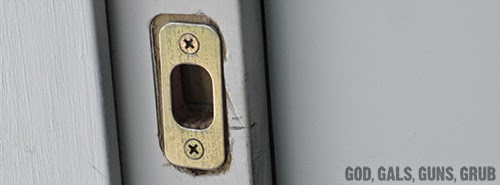
Most residential doors, even "steel" entry doors, are very weak compared to commercial steel doors in many commercial buildings. The key areas of weakness are primarily found in the hinge attachment points and the locking points on each side of the door. Most residential doors, even "steel" doors are just a thin steel or laminate covering over a wood particle or even foam and wood core. Here you can see a typical locking plate for a deadbolt lock for a "steel" entry door as it comes in the door frame from a lock big box home improvement center:


There is barely a three-quarter of an inch thick pine or poplar wood door frame/jamb holding the locking plate for the "steel" entry door.


This area typically breaks right out and splinters when the door is "kicked" in.


The easiest and cheapest door reinforcement you can do is replace the standard three-quarter-inch or one-inch screws holding the hinges and locking plates in place with two to three-inch long screws that go through the door frame/jamb and into the two-by-four or two-by-six wall studs that frame the doorway.


An additional step would be adding a heavy-duty lock plate with longer screws.  The heavier gauge steel lock plate with four long screws securing it to the studs behind the jamb will hold far better than the thin door jamb by itself.


The most thorough reinforcement of existing doors would probably the installation of a kit such as a Door Devil or EZ Armor by Armor Concepts.  If you have a door that has already been kicked in, if most of the damage is just the door jamb being broken out, many of these types of kits can be used to repair and reinforce your existing door.

Again, these tips will not prevent a door from being kicked in or being breached, but it will help buy you time and slow down many bad guys. If you are in the process of new construction, there are many other steps and purchasing choices you can make to have stronger, more fortified doors. but for now, the gals and I hope this helps you with... Keeping your doors closed...